Django — The Complete Guide, Illustrated with a Small CRM
Last reviewed: 2026-09-18
Purpose: Every Django concept you need, taught from a single running example — a small CRM — so a beginner can follow one application from first migration to production deployment, and an experienced developer can use the reference tables as a cheat sheet.
Contents
- How to Use This Article
- Overview
- The Example Application
- Setup
- Projects and Apps
- Settings
- URLs and the Request Lifecycle
- Views
- Templates
- Models
- The ORM in Depth
- Migrations
- Forms
- The Django Admin
- Authentication and Permissions
- Class-Based Views in Practice
- Middleware
- Signals
- The REST API with DRF
- Background Tasks, Caching and Async
- Internationalisation
- Security
- Performance
- Testing
- Management Commands
- Deployment
- Project Structure
- Anti-Patterns
- Cheat Sheet
- Further Reading
How to Use This Article
Two reading paths, one article:
- New to Django — read top to bottom. Every concept is introduced through the same CRM, and each section shows the code you would write next in that application.
- Experienced — jump to the Cheat Sheet for the reference tables (ORM lookups,
manage.pycommands, decorators, settings), then use the sections as the explanation behind each row.
Editable diagrams. Every illustration is a draw.io file. The .drawio sources ship next to this article in the KB, and a copy you can edit lives in Drive: Django CRM Diagrams (KB).
Overview
Django is a batteries-included web framework: a URL router, a template engine, an ORM, a migration system, a form library, an authentication system, an admin interface and a security layer — all shipped together and all designed to work with each other.
That is the whole argument, and it is worth stating plainly because it explains every design decision you will meet:
Django gives you one documented, supported way to do each thing, so that a new developer can read your codebase and know where everything lives.
Two consequences follow:
- You spend your time on the domain, not the plumbing. In this article, almost all the code concerns accounts, contacts and deals — not session handling or form validation.
- You accept the framework's opinions. The admin, the template language, the ORM and the request/response cycle all have a shape. Fighting them costs more than learning them.
The one architectural idea: MTV
Django calls its pattern MTV — Model, Template, View. It is the same separation as MVC with renamed parts:
| Layer | Responsibility | Where it lives |
|---|---|---|
| Model | Data structure and rules; talks to the database | models.py |
| Template | Presentation — how data becomes HTML | templates/ |
| View | Orchestration — receives a request, fetches data, returns a response | views.py |
| (URLconf) | Routing — which view handles which URL | urls.py |
The important subtlety: in Django the View is what other frameworks call a controller, and the Template is what they call the view. The names matter less than the split: data, presentation, and the glue between them are separate files, and the split is repeated inside every app.
The request path
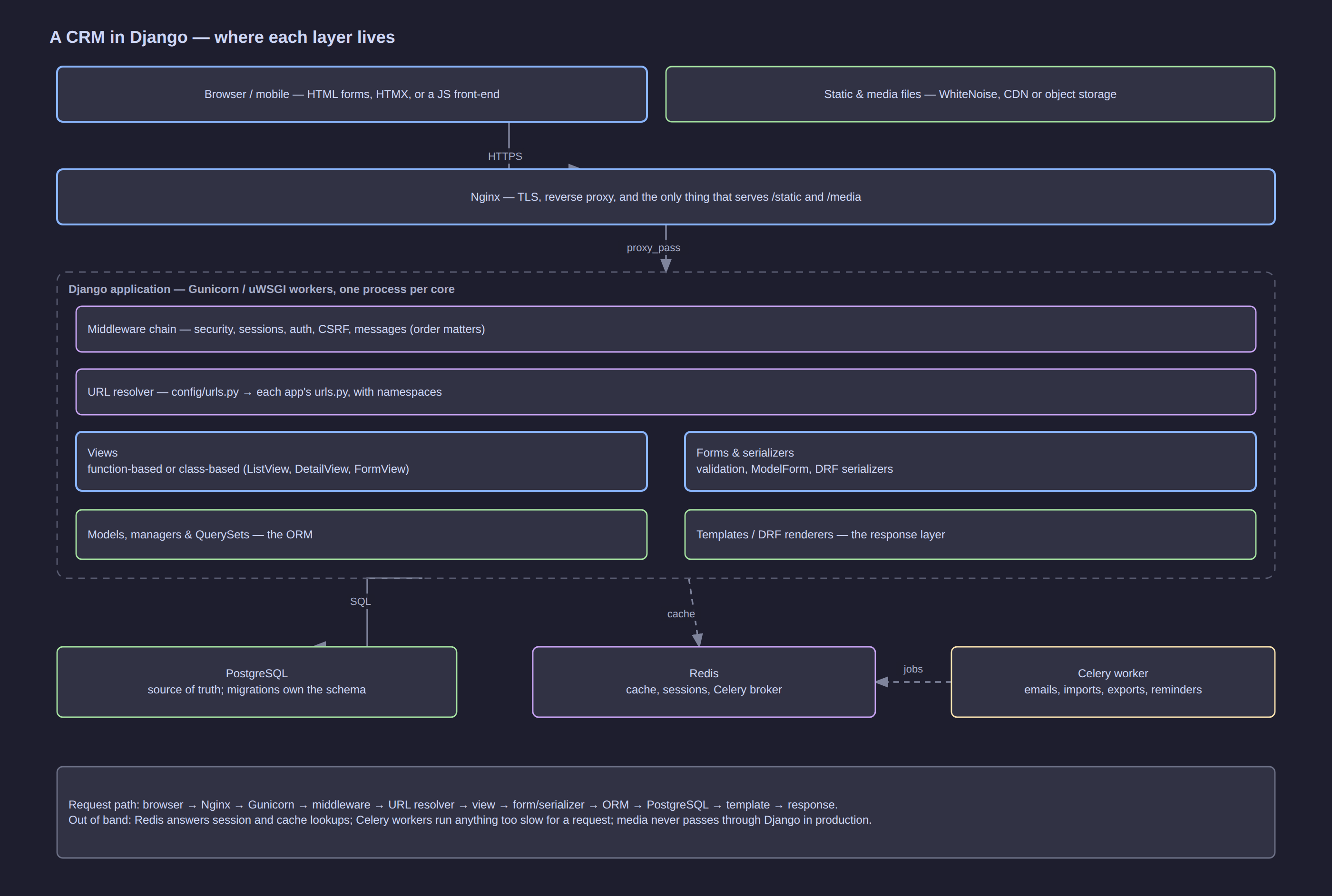
Click the diagram to open it at full resolution.
A request is a straight line through the boxes above, and every Django feature you will learn attaches to one of them:
- Nginx terminates TLS and is the only component that serves static files in production.
- Gunicorn runs several Django worker processes.
- Middleware processes the request — security headers, session loading, the authenticated user, CSRF checks.
- The URL resolver matches the path and imports the view.
- The view runs: it queries the ORM, validates a form, and returns a response.
- The template (or a DRF serializer) turns data into HTML or JSON.
- PostgreSQL is the source of truth; Redis holds cache and sessions; Celery runs slow work outside the request.
[!NOTE] Django is a server-rendered framework. The HTML is produced on the server, not assembled in the browser, and the page you ship works without a JavaScript build step. You can layer a JavaScript front-end on top later — but you do not have to, and a CRM built entirely with Django templates is a perfectly good product.
Why it is still a default choice
| Strength | What it means for the CRM |
|---|---|
| The admin | A usable back office on day one; internal users get create/edit/search/permissions for free |
| ORM + migrations | Schema changes are code, reviewed and reversible |
| Auth and permissions built in | Users, groups, per-object permissions, password hashing, session security |
| Security defaults | CSRF, XSS escaping and SQL-injection protection are on by default, not opt-in |
| Documentation | Extensive, versioned, and the answer to most questions |
| Deployment story | Well-trodden: Gunicorn, Nginx, PostgreSQL, static files, migrations |
The Example Application
One example threads through this guide: a small CRM — the sales application a B2B company runs. It is deliberately ordinary, because CRM screens exercise every part of Django you will need in a real project.
The domain
| Entity | What it is | Key relationships |
|---|---|---|
| User | A sales rep, manager or admin | owns accounts, contacts, deals |
| Account | A company you sell to | has many contacts and deals |
| Contact | A person at an account | belongs to one account |
| Lead | An unqualified prospect | converts into a Contact (+ Account + Deal) |
| PipelineStage | A stage of the sales process | classifies deals; carries a probability |
| Deal | An opportunity being worked | one account, one primary contact, one stage, one owner |
| Activity | A call, email, meeting or note | logged against a contact and/or a deal |
| Tag | Free-form labels | attached to contacts and deals |
The screens
| Screen | What it does | Django features it exercises |
|---|---|---|
| Pipeline board | Deals grouped by stage, totals per column | aggregation, filtering, template logic |
| Contact list | search, filter by account/owner/tag, paginate | QuerySets, select_related, Paginator |
| Contact detail | profile, deal history, activity timeline | related managers, prefetch_related |
| Deal detail | stage changes, line items, activity log | ModelForm, formsets, transactions |
| Lead inbox | unqualified leads, convert to contact | a service function, atomic() |
| CSV import | bulk-load a contact list | a Celery task, validation, reporting |
| Team admin | users, roles, assignment | Django admin, permissions |
| REST API | the same data for a mobile app | DRF serializers, viewsets, pagination |
The apps
The CRM is not one big app — it is several small ones, each owning one part of the domain:
crm/
├── config/           # settings, root URLconf, WSGI/ASGI entry points
├── accounts/         # Account — the companies
├── contacts/         # Contact, ContactTag, CSV import
├── leads/            # Lead + the conversion service
├── deals/            # Deal, PipelineStage, DealLine
├── activities/       # Activity — calls, emails, meetings, notes
├── users/            # custom User, teams, profile
├── core/             # base templates, mixins, pagination, utilities
└── api/              # DRF router, shared permissions, pagination defaults
That layout is the article's spine: every section below adds files to one of these apps.
The data model
You will meet the full model code in Models, and the relations are worth previewing because everything else depends on them:
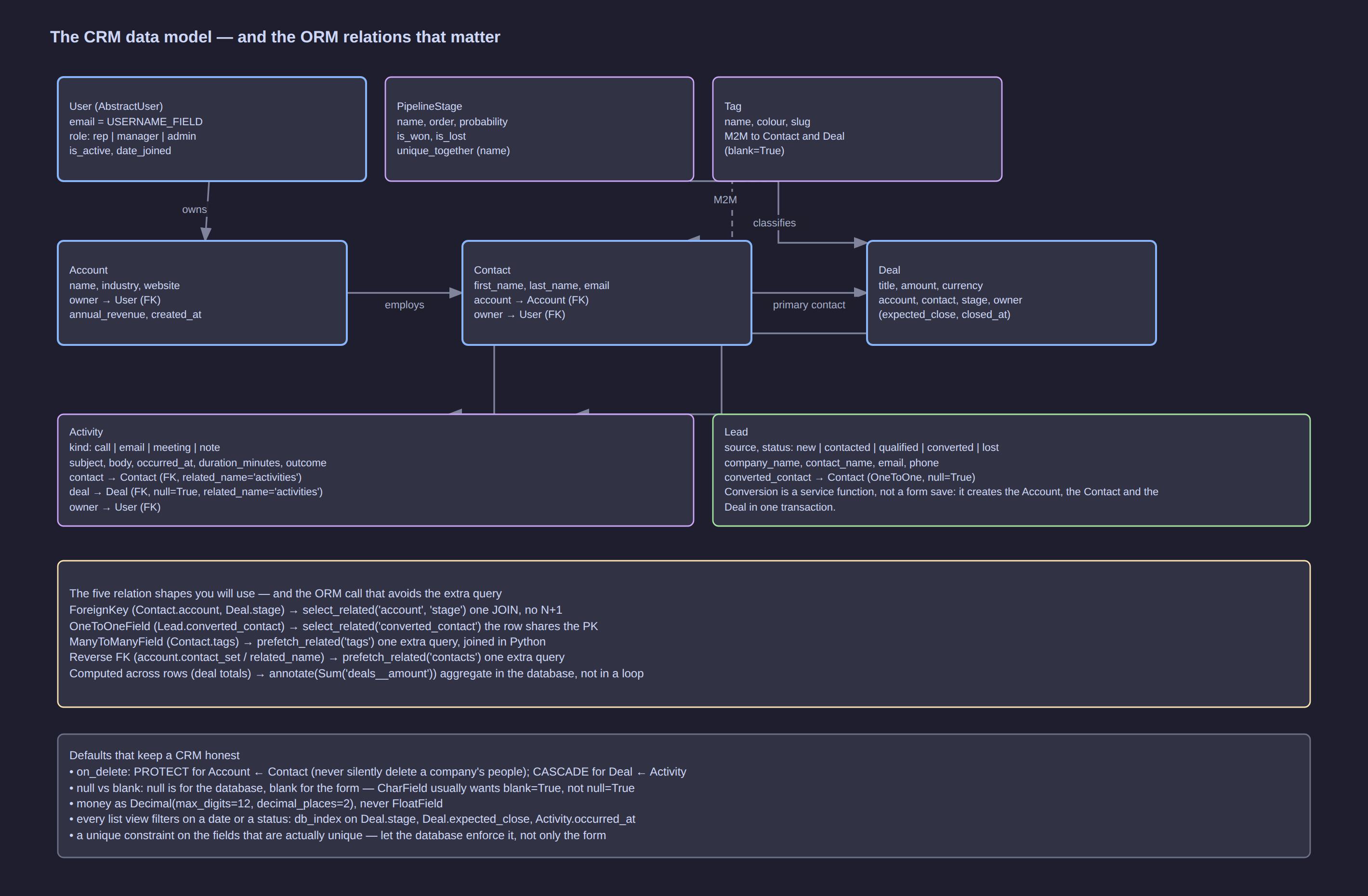
Click the diagram to open it at full resolution.
The REST API it exposes
GET    /api/v1/accounts/                        list, filter by industry/owner
GET    /api/v1/contacts/?search=&account=&tag=   search + filter + paginate
POST   /api/v1/contacts/                         create
PATCH  /api/v1/contacts/{id}/                    partial update
GET    /api/v1/deals/?stage=&owner=              the mobile app's pipeline view
POST   /api/v1/deals/{id}/move/                  custom action: change stage
GET    /api/v1/activities/?contact={id}          the timeline
POST   /api/v1/leads/{id}/convert/               custom action: convert a lead
GET    /api/v1/whoami/                           current user + permissions
Setup
Install and create the project
mkdir crm && cd crm
python3 -m venv .venv && source .venv/bin/activate

pip install "Django>=5.0" psycopg[binary] django-environ
pip freeze > requirements.txt

django-admin startproject config .        # note the trailing dot: no nested folder
python manage.py startapp contacts
startproject config . creates the project (settings and entry points) in the current directory, so the layout is flat:
crm/
├── manage.py              # the CLI you will use constantly
├── config/
│   ├── settings.py
│   ├── urls.py            # the root URLconf
│   ├── wsgi.py            # sync entry point
│   └── asgi.py            # async entry point
└── contacts/              # an app
    ├── models.py
    ├── views.py
    ├── admin.py
    ├── apps.py
    ├── migrations/
    └── tests.py
python manage.py migrate          # create Django's own tables
python manage.py createsuperuser
python manage.py runserver        # http://127.0.0.1:8000
Development vs production dependencies
# requirements.in — what you actually chose
Django>=5.0
psycopg[binary]
django-environ
djangorestframework
django-filter
celery[redis]
redis
gunicorn
whitenoise

# requirements-dev.in — never in production
pytest-django
factory-boy
django-debug-toolbar
ruff
coverage
[!TIP] Pin your dependencies and commit the lock file. A Django project that cannot be installed reproducibly in two years is a Django project you cannot patch.
The two commands you will run a thousand times
python manage.py makemigrations        # write migration files from model changes
python manage.py migrate               # apply them to the database
python manage.py shell                 # an interactive shell with the ORM loaded
python manage.py check --deploy        # the security checklist before you ship
python manage.py test                  # run the test suite
Projects and Apps
A project is the deployment; an app is a reusable unit of functionality. The CRM project contains seven apps. This distinction is the first thing that confuses newcomers, so make it concrete:
Project (config/) |
App (contacts/) |
|
|---|---|---|
| Contains | settings, root URLconf, WSGI/ASGI | models, views, templates, migrations |
| How many | exactly one | as many as the domain needs |
| Reusable | no | yes — an app can be copied into another project |
| Grows with | deployment concerns | features |
# contacts/apps.py
from django.apps import AppConfig

class ContactsConfig(AppConfig):
    default_auto_field = "django.db.models.BigAutoField"
    name = "contacts"
    verbose_name = "Contacts"

    def ready(self):
        from . import signals        # import signal receivers exactly once
# config/settings.py
INSTALLED_APPS = [
    # Django's own
    "django.contrib.admin",
    "django.contrib.auth",
    "django.contrib.contenttypes",
    "django.contrib.sessions",
    "django.contrib.messages",
    "django.contrib.staticfiles",
    # third party
    "rest_framework",
    "django_filters",
    # local — one line per domain area
    "core",
    "users",
    "accounts.apps.AccountsConfig",
    "contacts.apps.ContactsConfig",
    "leads",
    "deals",
    "activities",
]
How the layers repeat inside every app
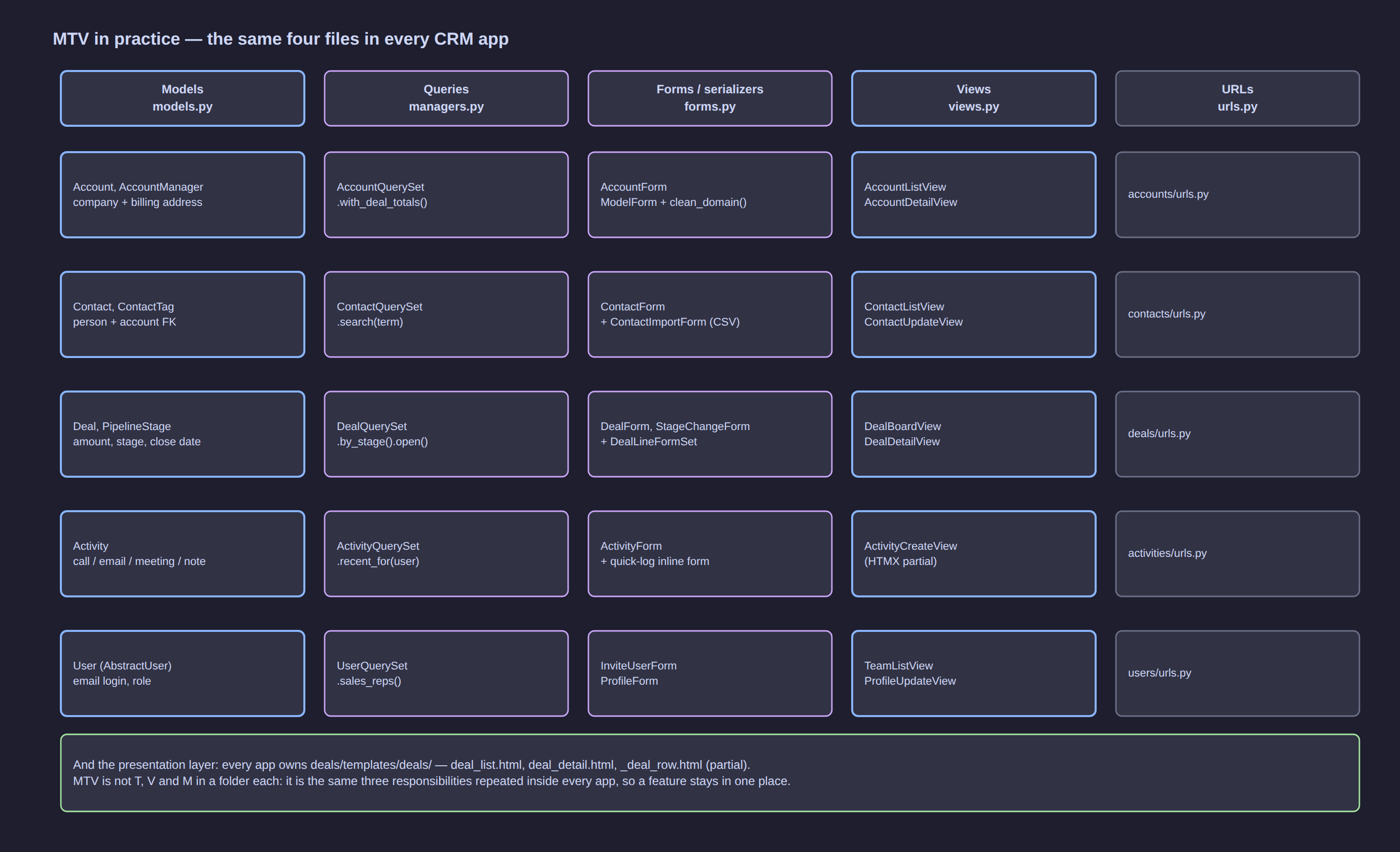
Click the diagram to open it at full resolution.
Read the grid by column: every app has the same five files, and each column is one layer of the framework. Read it by row: one row is one feature, complete and self-contained.
How to decide what belongs in a new app:
- It has its own models and its own screens → new app.
- It is a single model with no screens of its own → it probably belongs in an existing app.
- It is reusable across projects (an importer, a notification system) → its own app, with no project-specific imports.
[!WARNING] Do not create
utils.pygraveyards or acommon/app that everything imports. Shared code that grows without a domain home is how a Django project becomes unreadable. Put it where it is used until a second user appears, then promote it tocore/.
Settings
settings.py is the file that decides how everything else behaves. These are the settings that matter, with the values a CRM actually wants.
# config/settings.py
from pathlib import Path
import environ

BASE_DIR = Path(__file__).resolve().parent.parent

env = environ.Env(DEBUG=(bool, False))
environ.Env.read_env(BASE_DIR / ".env")

# --- secrets and safety -----------------------------------------------------
SECRET_KEY = env("DJANGO_SECRET_KEY")                  # NEVER committed
DEBUG = env("DJANGO_DEBUG")
ALLOWED_HOSTS = env.list("DJANGO_ALLOWED_HOSTS", default=["localhost", "127.0.0.1"])
CSRF_TRUSTED_ORIGINS = env.list("DJANGO_CSRF_TRUSTED_ORIGINS", default=[])

# --- applications -----------------------------------------------------------
INSTALLED_APPS = [...]                                  # see above
AUTH_USER_MODEL = "users.User"                          # set BEFORE the first migrate

# --- middleware (order matters) --------------------------------------------
MIDDLEWARE = [
    "django.middleware.security.SecurityMiddleware",
    "whitenoise.middleware.WhiteNoiseMiddleware",        # static files in production
    "django.contrib.sessions.middleware.SessionMiddleware",
    "django.middleware.locale.LocaleMiddleware",         # after session, before common
    "django.middleware.common.CommonMiddleware",
    "django.middleware.csrf.CsrfViewMiddleware",
    "django.contrib.auth.middleware.AuthenticationMiddleware",
    "django.contrib.messages.middleware.MessageMiddleware",
    "django.middleware.clickjacking.XFrameOptionsMiddleware",
]

# --- URLs and templates -----------------------------------------------------
ROOT_URLCONF = "config.urls"
WSGI_APPLICATION = "config.wsgi.application"
TEMPLATES = [{
    "BACKEND": "django.template.backends.django.DjangoTemplates",
    "DIRS": [BASE_DIR / "templates"],                    # project-wide templates
    "APP_DIRS": True,                                    # plus every app's templates/
    "OPTIONS": {"context_processors": [
        "django.template.context_processors.debug",
        "django.template.context_processors.request",
        "django.contrib.auth.context_processors.auth",
        "django.contrib.messages.context_processors.messages",
    ]},
}]

# --- database ---------------------------------------------------------------
DATABASES = {"default": env.db("DATABASE_URL")}          # postgres://user:pass@host:5432/crm

# --- identity ---------------------------------------------------------------
LANGUAGE_CODE = "en-us"
TIME_ZONE = "Europe/Paris"
USE_I18N = True                                          # translations enabled
USE_TZ = True                                            # store UTC, display local

# --- static and media -------------------------------------------------------
STATIC_URL = "/static/"
STATIC_ROOT = BASE_DIR / "staticfiles"                   # collectstatic target
STATICFILES_DIRS = [BASE_DIR / "static"]
MEDIA_URL = "/media/"
MEDIA_ROOT = BASE_DIR / "media"
STORAGES = {
    "default": {"BACKEND": "django.core.files.storage.FileSystemStorage"},
    "staticfiles": {"BACKEND": "whitenoise.storage.CompressedManifestStaticFilesStorage"},
}

# --- auth redirects ---------------------------------------------------------
LOGIN_URL = "users:login"
LOGIN_REDIRECT_URL = "deals:board"
LOGOUT_REDIRECT_URL = "users:login"

# --- email ------------------------------------------------------------------
EMAIL_BACKEND = env("EMAIL_BACKEND", default="django.core.mail.backends.console.EmailBackend")

# --- production hardening (harmless in dev, required in production) ---------
SECURE_SSL_REDIRECT = not DEBUG
SESSION_COOKIE_SECURE = not DEBUG
CSRF_COOKIE_SECURE = not DEBUG
SECURE_HSTS_SECONDS = 0 if DEBUG else 31536000
SECURE_HSTS_INCLUDE_SUBDOMAINS = not DEBUG
SECURE_HSTS_PRELOAD = not DEBUG
X_FRAME_OPTIONS = "DENY"
The handful of settings that bite
| Setting | Why it bites |
|---|---|
AUTH_USER_MODEL |
Must be set before the first migrate. Changing it later is a painful manual migration — decide on day one |
DEBUG |
Must be False in production. With ALLOWED_HOSTS empty, Django then refuses all requests (this is a feature) |
SECRET_KEY |
Rotating it invalidates sessions and signed tokens. Keep it in the environment, never in git |
ALLOWED_HOSTS |
Include the real domain; a wrong value produces a bare 400 with no explanation |
INSTALLED_APPS order |
admin before the apps it inspects; AUTH_USER_MODEL's app is fine anywhere |
MIDDLEWARE order |
SecurityMiddleware first, SessionMiddleware before AuthenticationMiddleware, LocaleMiddleware after session |
USE_TZ |
Leave it True and work in aware datetimes; naive datetimes are the cause of the classic "my report is off by two hours" bug |
STATIC_ROOT |
Different from STATICFILES_DIRS. Confusing them breaks collectstatic |
Split settings, environment variables, and secrets
# config/settings/base.py      — everything shared
# config/settings/dev.py       — DEBUG=True, console email, sqlite optional
# config/settings/prod.py      — DEBUG=False, real email, strict cookies, sentry
# .env — never committed; .env.example is
DJANGO_SECRET_KEY=...
DJANGO_DEBUG=False
DJANGO_ALLOWED_HOSTS=crm.example.com
DATABASE_URL=postgres://crm:...@localhost:5432/crm
REDIS_URL=redis://localhost:6379/0
# config/settings/prod.py
from .base import *          # noqa: F403
from .base import env

DEBUG = False
SENTRY_DSN = env("SENTRY_DSN", default="")
if SENTRY_DSN:
    import sentry_sdk
    sentry_sdk.init(dsn=SENTRY_DSN, traces_sample_rate=0.1)
[!WARNING]
from .base import *is the accepted idiom in split settings, but only becausebase.pycontains no logic worth hiding. Never put aSECRET_KEYliteral in any of these files — the value comes from the environment, and the environment is not in git.
URLs and the Request Lifecycle
One request, step by step
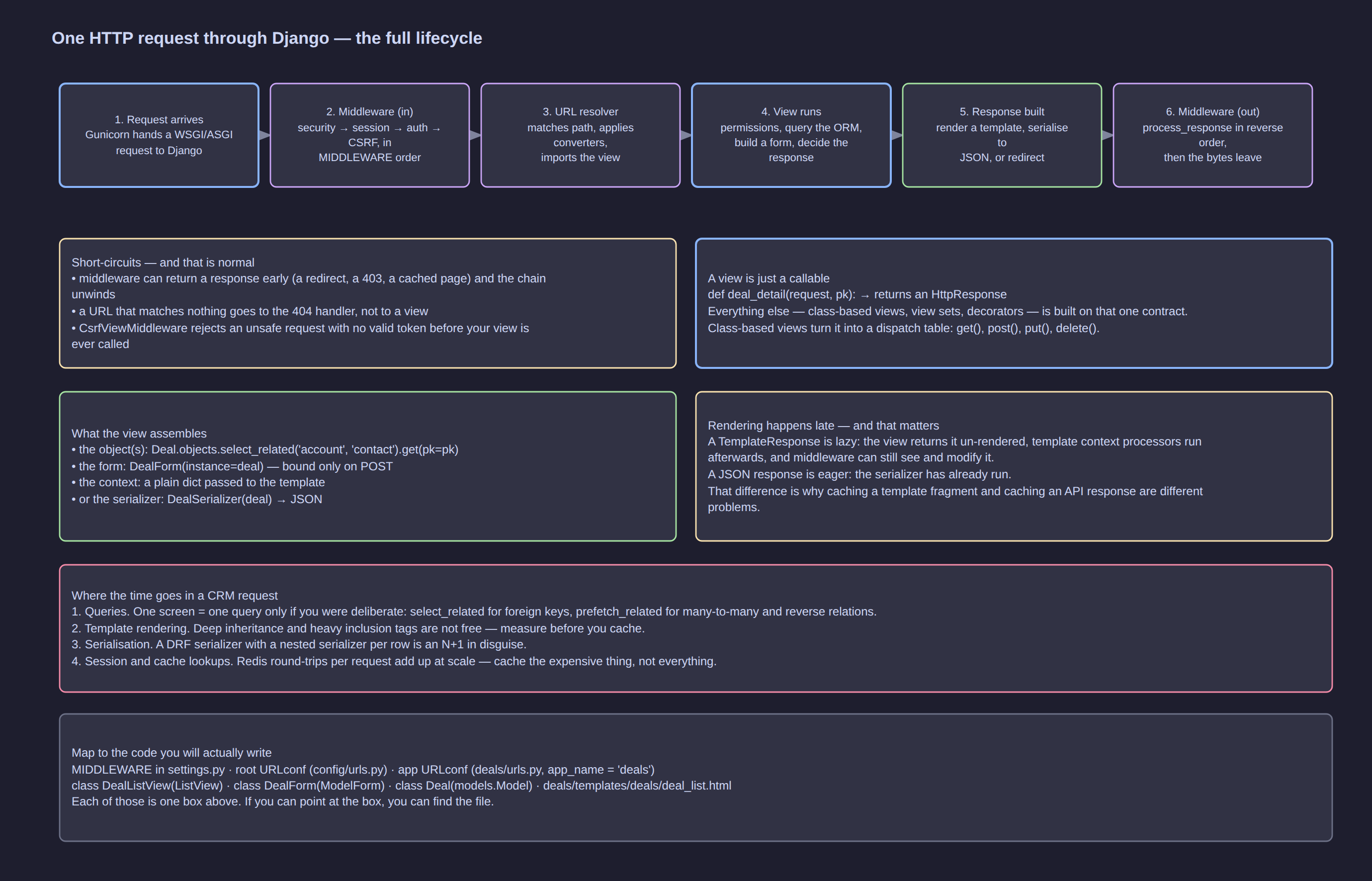
Click the diagram to open it at full resolution.
The lifecycle is the mental model for everything else: middleware wraps a URL resolver that calls a view that returns a response, and the response then unwinds back through the middleware.
Two details worth keeping:
- A view is just a callable taking a request and returning a response. Class-based views, viewsets and decorators are all conveniences over that contract.
- A
TemplateResponseis lazy. The view returns it un-rendered; context processors and middleware can still modify it afterwards. A JSON response, by contrast, is already computed.
The root URLconf
# config/urls.py
from django.conf import settings
from django.conf.urls.static import static
from django.contrib import admin
from django.urls import include, path

urlpatterns = [
    path("admin/", admin.site.urls),
    path("accounts/", include("accounts.urls")),
    path("contacts/", include("contacts.urls")),
    path("leads/", include("leads.urls")),
    path("deals/", include("deals.urls")),
    path("activities/", include("activities.urls")),
    path("users/", include("users.urls")),
    path("api/v1/", include("api.urls")),
]

if settings.DEBUG:
    urlpatterns += static(settings.MEDIA_URL, document_root=settings.MEDIA_ROOT)
App URLconfs, namespaces and converters
# deals/urls.py
from django.urls import path
from . import views

app_name = "deals"                      # namespacing: this is what makes reverse() safe

urlpatterns = [
    path("", views.DealBoardView.as_view(), name="board"),
    path("<int:pk>/", views.DealDetailView.as_view(), name="detail"),
    path("new/", views.DealCreateView.as_view(), name="create"),
    path("<int:pk>/edit/", views.DealUpdateView.as_view(), name="update"),
    path("<int:pk>/stage/", views.DealStageUpdateView.as_view(), name="stage"),
    path("<int:pk>/delete/", views.DealDeleteView.as_view(), name="delete"),
]
| Converter | Matches | Example URL |
|---|---|---|
<int:pk> |
a non-negative integer | /deals/42/ |
<slug:slug> |
letters, numbers, hyphens, underscores | /accounts/acme-corp/ |
<uuid:token> |
a UUID | /invites/9f1c…/ |
<str:name> |
any non-empty string without / |
/tags/vip/ |
<path:rest> |
anything, including / |
/files/2026/q1/report.csv |
Never build URLs by hand in a template or view. Use {% url %} and reverse():
from django.urls import reverse
from django.shortcuts import redirect

def confirm_deal(request, pk):
    ...
    return redirect("deals:detail", pk=pk)

# models: a canonical URL per object, used by the admin and by get_success_url
class Deal(models.Model):
    def get_absolute_url(self):
        return reverse("deals:detail", kwargs={"pk": self.pk})
[!TIP] A
name=on every route and a{% url %}in every template means renaming a URL is a one-line change. Hard-coded/deals/42/anywhere is a bug waiting for the next refactor.
Views
A view receives a HttpRequest and returns an HttpResponse (or raises). Everything else is style.
Function-based views: explicit and readable
# contacts/views.py
from django.contrib.auth.decorators import login_required
from django.core.paginator import Paginator
from django.db.models import Q
from django.shortcuts import get_object_or_404, render

from .models import Contact

@login_required
def contact_list(request):
    term = request.GET.get("search", "").strip()
    account_id = request.GET.get("account")
    owner = request.GET.get("owner")

    contacts = (
        Contact.objects
        .select_related("account", "owner")          # one query, not one per row
        .filter(is_active=True)
        .order_by("account__name", "last_name")
    )
    if term:
        contacts = contacts.filter(
            Q(first_name__icontains=term) | Q(last_name__icontains=term) | Q(email__icontains=term)
        )
    if account_id:
        contacts = contacts.filter(account_id=account_id)
    if owner == "me":
        contacts = contacts.filter(owner=request.user)

    page = Paginator(contacts, 25).get_page(request.GET.get("page"))

    return render(request, "contacts/contact_list.html", {
        "page": page,
        "term": term,
        "total": page.paginator.count,
    })
Use an FBV when: the logic is short, the flow has branches, or you want the whole thing visible in one screen. Most views in a CRM are like this — and most real Django codebases are a healthy mix.
Class-based views: reuse through configuration
# deals/views.py
from django.contrib.auth.mixins import LoginRequiredMixin, PermissionRequiredMixin
from django.views.generic import DetailView, ListView, UpdateView

from .models import Deal

class DealBoardView(LoginRequiredMixin, ListView):
    model = Deal
    template_name = "deals/board.html"
    context_object_name = "deals"
    paginate_by = 50

    def get_queryset(self):
        qs = (Deal.objects
              .select_related("account", "contact", "stage", "owner")
              .prefetch_related("activities"))
        if not self.request.user.role == "manager":
            qs = qs.filter(owner=self.request.user)     # reps see only their own deals
        if stage := self.request.GET.get("stage"):
            qs = qs.filter(stage__slug=stage)
        return qs

    def get_context_data(self, **kwargs):
        ctx = super().get_context_data(**kwargs)
        ctx["stages"] = PipelineStage.objects.order_by("order")
        ctx["totals_by_stage"] = {
            row["stage__name"]: row["total"]
            for row in self.get_queryset().values("stage__name")
                                        .annotate(total=Sum("amount"))
        }
        return ctx

class DealDetailView(LoginRequiredMixin, DetailView):
    model = Deal
    template_name = "deals/deal_detail.html"

    def get_queryset(self):
        return Deal.objects.select_related("account", "contact", "stage", "owner")

class DealUpdateView(LoginRequiredMixin, PermissionRequiredMixin, UpdateView):
    model = Deal
    form_class = DealForm
    template_name = "deals/deal_form.html"
    permission_required = "deals.change_deal"
The generic views encode three decades of common patterns. The full family, by purpose:
| Purpose | Generic view | What it does for you |
|---|---|---|
| Show one object | DetailView |
fetch by pk/slug, 404, context |
| Show a list | ListView |
queryset, context, paginate_by |
| Create | CreateView |
GET form, POST validation, save, redirect |
| Update | UpdateView |
load instance, bind form, save |
| Delete | DeleteView |
confirm page, delete, redirect |
| Show a template | TemplateView |
nothing else |
| Process a form | FormView |
form on GET, handle valid/invalid on POST |
| Dates | ArchiveIndexView, YearArchiveView, MonthArchiveView, DayArchiveView |
date-based archives |
| Edit a subformset | FormView + BaseInlineFormSet |
parent + children in one submit |
# The full inheritance chain, so you know where to change behaviour:
#   View  →  TemplateResponseMixin + ContextMixin
#         →  BaseDetailView / BaseListView
#         →  SingleObjectMixin / MultipleObjectMixin
#         →  DetailView / ListView
# Override a get_*() method rather than copying the whole view.
Which to use
| Function-based view | Class-based view | |
|---|---|---|
| Readability for irregular logic | high — top to bottom | lower — behaviour is spread across get_* methods |
| Reuse | decorators, helper functions | mixins, inheritance |
| CRUD | fine, but repeats | excellent — three lines per view |
| Traceability | obvious | requires knowing the MRO |
| Testability | equally good | equally good |
The pragmatic rule used throughout this article: CBVs for standard CRUD, FBVs for everything irregular. Neither is "more correct", and a codebase that uses only one of them is usually fighting itself somewhere.
Permissions on a view
from django.contrib.auth.decorators import login_required, permission_required

@login_required
@permission_required("contacts.change_contact", raise_exception=True)
def contact_edit(request, pk): ...

# class-based equivalent
class ContactUpdateView(LoginRequiredMixin, PermissionRequiredMixin, UpdateView):
    permission_required = "contacts.change_contact"
    raise_exception = True
Templates
Django's template language (DTL) is deliberately limited: it can display data and branch on it, and it is hard to put business logic in it. That is the point — presentation logic stays in templates/, and everything else stays in Python.
Template discovery, inheritance and inclusion
{# templates/base.html — project-wide #}
{% load static %}
<!doctype html>
<html lang="{{ LANGUAGE_CODE }}">
<head>
  <meta charset="utf-8">
  <meta name="viewport" content="width=device-width, initial-scale=1">
  <title>{% block title %}CRM{% endblock %}</title>
  <link rel="stylesheet" href="{% static 'css/app.css' %}">
</head>
<body class="app">
  <nav class="sidebar">{% include "partials/_nav.html" %}</nav>

  <main>
    {% if messages %}
      <ul class="messages">
        {% for message in messages %}<li class="{{ message.tags }}">{{ message }}</li>{% endfor %}
      </ul>
    {% endif %}

    {% block content %}{% endblock %}
  </main>
</body>
</html>
{# deals/templates/deals/board.html — an app template #}
{% extends "base.html" %}
{% load humanize %}

{% block title %}Pipeline — CRM{% endblock %}

{% block content %}
  <h1>Pipeline</h1>

  <form method="get" class="filters">
    <input type="search" name="search" value="{{ request.GET.search }}" placeholder="Search deals…">
    <select name="stage">
      <option value="">All stages</option>
      {% for stage in stages %}
        <option value="{{ stage.slug }}" {% if request.GET.stage == stage.slug %}selected{% endif %}>
          {{ stage.name }}
        </option>
      {% endfor %}
    </select>
    <button type="submit">Filter</button>
  </form>

  <div class="board">
    {% for stage, deals in grouped.items %}
      <section class="column">
        <h2>{{ stage }} <small>{{ totals_by_stage|get_item:stage|default:0|floatformat:0 }} €</small></h2>
        {% for deal in deals %}
          {% include "deals/_deal_card.html" with deal=deal only %}
        {% empty %}
          <p class="empty">No deals in this stage.</p>
        {% endfor %}
      </section>
    {% endfor %}
  </div>

  {% include "partials/_pagination.html" with page=page %}
{% endblock %}
| Concept | Syntax | Notes |
|---|---|---|
| Inheritance | {% extends "base.html" %} + {% block %} |
one base layout, per-page blocks |
| Inclusion | {% include "x.html" with a=1 only %} |
only prevents context leakage — use it |
| Variables | {{ deal.title }} |
dots walk attributes, dict keys and list indices |
| Filters | {{ amount\|floatformat:2 }}, {{ name\|title }} |
pipe-chained, left to right |
| Conditionals | {% if %}…{% elif %}…{% else %}…{% endif %} |
no parentheses; and/or/not |
| Loops | {% for %} with forloop.counter, empty |
{% empty %} is the "no results" branch |
| URLs | {% url 'deals:detail' deal.pk %} |
never hard-code a path |
| Static | {% static 'css/app.css' %} |
respects STATIC_URL and hashing |
| CSRF | {% csrf_token %} |
mandatory in every POST form |
| Escaping | {{ value }} escapes HTML automatically |
\|safe opts out — treat it as a code smell |
Escaping, and the one time you turn it off
DTL auto-escapes every variable, which is why XSS is rare in Django. |safe and {% autoescape off %} disable that protection for a value, so they may only ever wrap your own generated HTML:
{# Safe: our own markup from a trusted source #}
{{ rendered_rich_text_from_our_editor|safe }}

{# Never: anything a user typed #}
{{ contact.notes|safe }}          {# ← stored XSS waiting to happen #}
Context processors
A context processor injects a variable into every template. Django ships four; a CRM usually adds one or two:
# core/context_processors.py
def crm_globals(request):
    if not request.user.is_authenticated:
        return {}
    return {
        "open_deals_count": Deal.objects.open().filter(owner=request.user).count(),
        "nav_active": request.resolver_match.namespace if request.resolver_match else "",
    }
# settings.py — TEMPLATES[0]["OPTIONS"]["context_processors"]
"core.context_processors.crm_globals",
[!WARNING] A context processor runs on every template render, including emails and error pages. A query in one is a query on every page — cache it or drop it.
Custom filters and tags
# deals/templatetags/deal_extras.py
from django import template

register = template.Library()

@register.filter
def money(value):
    """€ 1 234,50 — and blank rather than 'None' for a missing amount."""
    if value is None:
        return "—"
    return f"{value:,.2f} €".replace(",", " ").replace(".", ",").replace(" ", " ", 1)

@register.simple_tag
def stage_progress(stage):
    return f"{stage.probability * 100:.0f}%"
templatetags/ must contain an __init__.py, and the app must be in INSTALLED_APPS.
Partials and server-rendered interactivity
Split templates the way you split components: small files named _partial.html for fragments. A single partial can serve both a full page and an AJAX/HTMX update:
# activities/views.py — returns a fragment for HTMX, a full page for a normal request
class ActivityCreateView(LoginRequiredMixin, CreateView):
    model = Activity
    form_class = ActivityForm
    template_name = "activities/_timeline_item.html"

    def get_template_names(self):
        return ([self.template_name] if self.request.headers.get("HX-Request")
                else ["activities/activity_form.html"])
That one pattern gives you a fast, interactive CRM without a JavaScript build step — the server renders HTML fragments, the browser swaps them in.
Models
A model is a Python class that describes a database table. Everything the database enforces — types, nullability, uniqueness, relations, indexes — belongs here, not in a form and not in a view.
# accounts/models.py
from django.conf import settings
from django.db import models
from django.urls import reverse

class AccountQuerySet(models.QuerySet):
    def active(self):
        return self.filter(is_active=True)

    def with_deal_totals(self):
        return self.annotate(
            open_deal_total=models.Sum("deals__amount",
                                       filter=models.Q(deals__closed_at__isnull=True)),
            contact_count=models.Count("contacts", distinct=True),
        )

class AccountManager(models.Manager.from_queryset(AccountQuerySet)):
    pass

class Account(models.Model):
    class Industry(models.TextChoices):
        RETAIL = "retail", "Retail"
        INDUSTRY = "industry", "Industry"
        SERVICES = "services", "Services"
        PUBLIC = "public", "Public sector"

    name = models.CharField(max_length=200, db_index=True)
    industry = models.CharField(max_length=20, choices=Industry.choices, default=Industry.SERVICES)
    website = models.URLField(blank=True)
    annual_revenue = models.DecimalField(max_digits=14, decimal_places=2, null=True, blank=True)
    owner = models.ForeignKey(settings.AUTH_USER_MODEL, on_delete=models.PROTECT,
                              related_name="owned_accounts")
    is_active = models.BooleanField(default=True)
    created_at = models.DateTimeField(auto_now_add=True)
    updated_at = models.DateTimeField(auto_now=True)

    objects = AccountManager()

    class Meta:
        ordering = ["name"]
        constraints = [
            models.UniqueConstraint(fields=["name"], name="unique_account_name"),
        ]
        indexes = [
            models.Index(fields=["industry", "is_active"]),
        ]

    def __str__(self):
        return self.name

    def get_absolute_url(self):
        return reverse("accounts:detail", kwargs={"pk": self.pk})
# contacts/models.py
class Contact(models.Model):
    first_name = models.CharField(max_length=80)
    last_name = models.CharField(max_length=80)
    email = models.EmailField(unique=True)
    phone = models.CharField(max_length=40, blank=True)
    account = models.ForeignKey("accounts.Account", on_delete=models.PROTECT,
                                related_name="contacts")
    owner = models.ForeignKey(settings.AUTH_USER_MODEL, on_delete=models.PROTECT,
                              related_name="owned_contacts")
    tags = models.ManyToManyField("contacts.Tag", blank=True, related_name="contacts")
    is_active = models.BooleanField(default=True)
    created_at = models.DateTimeField(auto_now_add=True)

    class Meta:
        ordering = ["last_name", "first_name"]
        indexes = [models.Index(fields=["account", "last_name"])]

    def __str__(self):
        return f"{self.first_name} {self.last_name}"
Fields you will actually use
| Field | Use it for | Watch out |
|---|---|---|
CharField(max_length) |
short text | max_length is enforced by the database |
TextField |
long text, notes | no length limit; use for rich text |
EmailField, URLField, SlugField |
validated strings | EmailField on the user model is what makes email login work |
IntegerField, PositiveIntegerField |
counters, quantities | |
DecimalField(max_digits, decimal_places) |
money | never FloatField for money — floats do not round like money |
BooleanField |
flags | prefer this over a nullable boolean |
DateTimeField(auto_now_add / auto_now) |
created / updated | auto_now_add is set once; auto_now on every save |
DateField |
business dates | expected_close, closed_at |
FileField, ImageField |
uploads | upload_to is a callable for a reason; validate content type |
JSONField |
flexible, rarely-queried data | do not model your domain in one |
ForeignKey |
"one account, many contacts" | on_delete is a required decision, not a formality |
OneToOneField |
"extends" or "at most one" | the row shares the primary key |
ManyToManyField |
"tags" | needs through= as soon as the link has its own fields |
on_delete — decide on purpose
| Value | Meaning | Use for |
|---|---|---|
PROTECT |
refuse to delete the parent while children exist | Account ← Contact: never silently delete a company's people |
RESTRICT |
like PROTECT, but allows deletion if the child is deleted in the same operation |
softer version of the same idea |
CASCADE |
delete children with the parent | Deal ← Activity: an activity without its deal is noise |
SET_NULL |
keep the child, null the relation | owner when an employee leaves |
SET_DEFAULT / SET(value) |
reassign | reassigning to a "former employee" account |
DO_NOTHING |
leave it to the database | only with a database-level constraint |
Null versus blank, and why it confuses everyone
name = models.CharField(max_length=100, blank=True)          # "" is a legal value: this is what you want
notes = models.TextField(null=True, blank=True)              # NULL and "" both allowed
price = models.DecimalField(..., null=True, blank=True)      # NULL means "unknown", not zero
blankis a validation concept: may the form field be empty?nullis a database concept: may the column store NULL?
On a text field, prefer blank=True alone — Django's own convention is that an empty string is the right representation of "no value" for text, and having both "" and NULL means every query must handle two kinds of empty.
Meta options worth setting
| Option | Effect |
|---|---|
ordering |
default order of every queryset — set it, or your lists shuffle randomly |
constraints |
database-enforced rules: unique together, check constraints |
indexes |
explicit indexes for the columns your list views filter and sort on |
verbose_name / verbose_name_plural |
the admin's labels |
permissions |
custom permissions beyond add/change/delete/view |
abstract = True |
a base class that creates no table |
class Meta:
    constraints = [
        models.UniqueConstraint(fields=["deal", "position"], name="unique_line_position"),
        models.CheckConstraint(check=models.Q(quantity__gte=1), name="line_quantity_positive"),
        models.CheckConstraint(check=models.Q(amount__gte=0), name="deal_amount_non_negative"),
    ]
[!TIP] Constraints in
Metaare the difference between "we validate it in the form" and "the data cannot be wrong". Every rule you can push into the database is a class of bug you never debug again — and it also protects the admin, a management command and a data import.
Model rules that belong on the model
class Deal(models.Model):
    ...
    clean(self):
        from django.core.exceptions import ValidationError
        if self.stage and self.stage.is_won and self.amount <= 0:
            raise ValidationError({"amount": "A won deal must have a positive amount."})

    def save(self, *args, **kwargs):
        self.amount = (self.amount or 0).quantize(Decimal("0.01"))
        super().save(*args, **kwargs)

    @property
    def is_open(self):
        return self.closed_at is None and not self.stage.is_lost

    def close(self, *, won: bool):
        """Business action — called from a view, a task or a command."""
        self.stage = PipelineStage.objects.get(is_won=won)
        self.closed_at = timezone.now()
        self.save(update_fields=["stage", "closed_at", "updated_at"])
clean() is called by forms and the admin, save() on every write. Put validation in clean() (so it produces a form error) and normalisation in save() — and remember neither runs on QuerySet.update(), which is one reason bulk writes go through a service function.
The ORM in Depth
The ORM is where Django code is won or lost: almost every performance problem in a Django CRM is a query problem, and almost every query problem is an N+1 in disguise. The diagram is the whole section in one picture.
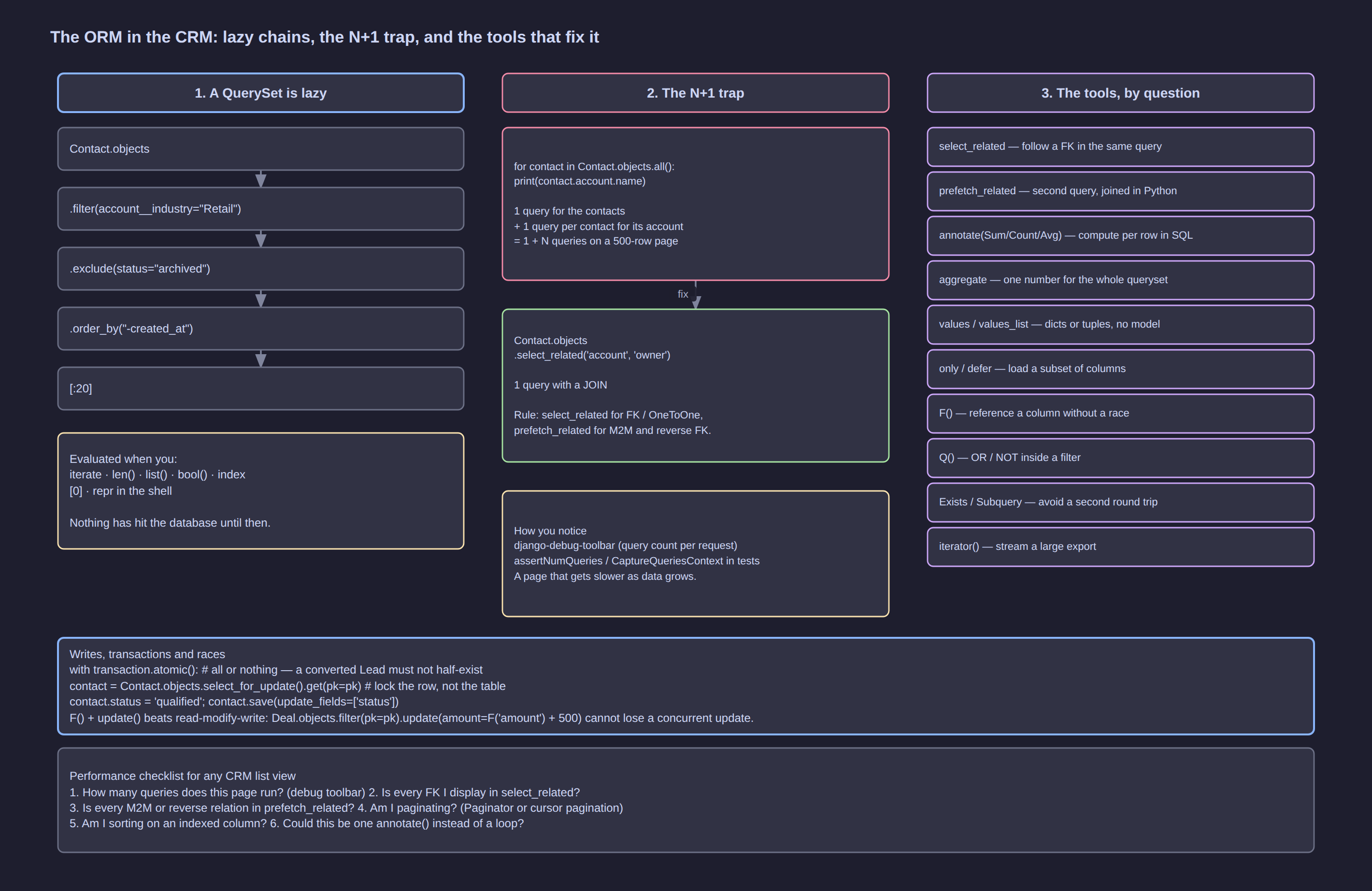
Click the diagram to open it at full resolution.
A QuerySet is lazy
Building a queryset does no database work at all. It is a description of a query, and each chained method returns a new description:
qs = (Contact.objects                      # nothing yet
      .filter(account__industry="retail")  # still nothing
      .exclude(is_active=False)            # still nothing
      .order_by("-created_at")             # still nothing
      [:20])                               # still nothing — LIMIT 20
It runs when you evaluate it:
list(qs)          # evaluate → list of model instances
for c in qs:      # evaluate → iteration
len(qs)           # evaluate (and fetch every row!) — prefer qs.count()
qs.exists()       # a cheap SELECT 1 LIMIT 1
qs[0]             # evaluate, LIMIT 1
bool(qs)          # evaluate
Two consequences:
- Compose freely. Filters can be added by the view, the manager and a helper function; the SQL is only built at the end.
- Cache deliberately. Once evaluated, a queryset caches its results — iterating twice does not re-query if you iterate the same queryset object.
contacts = Contact.objects.filter(is_active=True)
len(contacts)                       # runs the query, caches all rows
[c.last_name for c in contacts]     # no second query — cached

contacts = Contact.objects.filter(is_active=True)
contacts.count()                    # SELECT COUNT(*)
[c.last_name for c in contacts]     # a SECOND query, fetching every row
Lookups, F(), Q()
Deal.objects.filter(stage__name="Proposal")                 # follow a FK in the lookup
Deal.objects.filter(amount__gte=1000, amount__lt=5000)       # range
Deal.objects.filter(title__icontains="renewal")              # case-insensitive contains
Deal.objects.filter(created_at__date=date.today())           # date part
Deal.objects.filter(expected_close__isnull=True)             # no value
Deal.objects.filter(owner__email__endswith="@acme.com")      # deep joins
Deal.objects.filter(id__in=[1, 2, 3])
| Suffix | Meaning |
|---|---|
__exact (default), __iexact |
equality, case-insensitive equality |
__contains, __icontains |
substring |
__startswith, __istartswith, __endswith |
prefix / suffix |
__gt, __gte, __lt, __lte |
comparison |
__in, __range, __isnull |
membership, range, null check |
__date, __year, __month, __day, __week_day |
date parts |
__regex |
regular expression (rarely the right answer) |
from django.db.models import F, Q

# F(): reference a column in the database, no read-modify-write race
Deal.objects.filter(pk=pk).update(amount=F("amount") + 500)
Contact.objects.filter(pk=pk).update(last_called_at=F("created_at"))

# Q(): compose OR / NOT, which filter() alone cannot express
Contact.objects.filter(Q(account__industry="retail") | Q(tags__name="vip")).distinct()
Contact.objects.filter(~Q(email__endswith="@internal.acme.com"))
Contact.objects.filter(Q(owner=user) & (Q(is_active=True) | Q(account__is_active=True)))
Aggregation and annotation
from django.db.models import Avg, Count, Max, Sum

# aggregate — one row, one number for the whole queryset
Deal.objects.open().aggregate(total=Sum("amount"), average=Avg("amount"), count=Count("id"))
# {'total': Decimal('184500.00'), 'average': Decimal('6150.00'), 'count': 30}

# annotate — one value PER row, computed in SQL
Account.objects.annotate(
    open_total=Sum("deals__amount", filter=Q(deals__closed_at__isnull=True)),
    contact_count=Count("contacts", distinct=True),
).filter(open_total__gt=10000).order_by("-open_total")

# Group by, the ORM way
PipelineStage.objects.annotate(
    deal_count=Count("deals"),
    total=Sum("deals__amount"),
).order_by("order")

# values() when you only need a report, not model instances
Deal.objects.values("stage__name").annotate(total=Sum("amount"), n=Count("id"))
[!IMPORTANT]
Sumover a reverse relation plus another aggregation in the sameannotate()multiplies rows and inflates both numbers. Adddistinct=Trueto the counts, or split the query. This is the most common silent-wrong-number bug in Django reporting code.
select_related and prefetch_related — the N+1 fix
# ❌ 1 + N queries: one per row when the template touches contact.account
for contact in Contact.objects.all():
    print(contact.account.name)

# ✅ 1 query, with a JOIN — for ForeignKey and OneToOneField
for contact in Contact.objects.select_related("account", "owner"):
    print(contact.account.name)

# ✅ 2 queries, joined in Python — for ManyToMany and reverse FK
for account in Account.objects.prefetch_related("contacts"):
    for contact in account.contacts.all():
        ...

# ✅ combine them; and prefetch a filtered/nested set when needed
Deal.objects.select_related("account", "stage", "owner").prefetch_related(
    Prefetch("activities", queryset=Activity.objects.filter(kind="call").order_by("-occurred_at"),
             to_attr="call_activities"),
)
| Situation | Tool | Queries | Notes |
|---|---|---|---|
| FK / OneToOne, forward | select_related |
1 (JOIN) | cheap, always prefer it |
reverse FK (account.contact_set) |
prefetch_related |
2 | one query, joined in Python |
| ManyToMany | prefetch_related |
2 | |
| Filtered/sorted children | Prefetch(queryset=…) |
2 | with to_attr= gives you a list, not a manager |
| Deep chain of FKs | select_related("a__b__c") |
1 | joins multiply rows: keep it to what you display |
| A count per row | annotate(Count(...)) |
1 | never loop COUNT(*) in Python |
How to notice you have a problem: django-debug-toolbar shows the query count per request. A contact list that runs 1 query for 25 contacts is right; one that runs 26 is an N+1.
# and lock it in with a test
def test_contact_list_query_count(self):
    self.client.force_login(self.user)
    with self.assertNumQueries(4):          # tune the number, then never regress
        self.client.get(reverse("contacts:list"))
Writes: bulk, transactions, races
from django.db import transaction
from django.db.models import F

# bulk_create / bulk_update — one query for many rows
Contact.objects.bulk_create([Contact(**row) for row in rows], batch_size=500)
Contact.objects.bulk_update(contacts, ["phone"], batch_size=500)

# update() bypasses save() and signals — cheap and deliberate
Contact.objects.filter(account=account).update(owner=new_owner)

# atomic(): all or nothing
with transaction.atomic():
    account = Account.objects.create(name="Acme", owner=user)
    Contact.objects.bulk_create([...])
    deal = Deal.objects.create(account=account, ...)      # any exception rolls all of it back

# select_for_update(): lock the rows you are about to change (inside a transaction)
with transaction.atomic():
    deal = Deal.objects.select_for_update().get(pk=pk)
    deal.amount = compute(deal)
    deal.save(update_fields=["amount"])

# atomic per-request, when almost everything in a view is a write
@transaction.atomic
def convert_lead(request, pk): ...
| Tool | Use it when |
|---|---|
transaction.atomic() |
several writes must succeed or fail together |
select_for_update() |
two requests could change the same row; needs a matching index and a short transaction |
F() expressions |
incrementing or comparing against the current value without a race |
update_fields=[...] |
you are saving one field and want to avoid a full-row UPDATE and its race |
bulk_* |
importing or updating hundreds of rows; remember it skips save()/signals |
on_commit() |
the side effect must wait until the transaction has actually committed |
from django.db import transaction

def convert_lead(lead, user):
    with transaction.atomic():
        account = Account.objects.create(name=lead.company_name, owner=user)
        contact = Contact.objects.create(
            first_name=lead.contact_name.split()[0], last_name=lead.contact_name.split()[-1],
            email=lead.email, account=account, owner=user,
        )
        lead.converted_contact = contact
        lead.status = Lead.Status.CONVERTED
        lead.save(update_fields=["converted_contact", "status"])
        transaction.on_commit(lambda: send_welcome_email.delay(contact.pk))
    return contact
[!WARNING] Side effects inside
atomic()are a classic footgun: the email is sent (or the Celery task queued) and then the transaction rolls back. Wrap external effects intransaction.on_commit()so they only happen once the data is durable.
Raw SQL and the escape hatch
# still returns model instances, and you can still filter it
Contact.objects.raw("SELECT * FROM contacts_contact WHERE email ILIKE %s", ["%@acme.com"])

# parameters everywhere: never format SQL with f-strings
from django.db import connection
with connection.cursor() as cur:
    cur.execute("SELECT stage_id, SUM(amount) FROM deals_deal GROUP BY stage_id")
    rows = cur.fetchall()
The ORM covers ~95% of a CRM. When it does not — a window function, a recursive CTE — use RawSQL, .extra() on an existing queryset, or raw SQL with bound parameters. Never build SQL by string interpolation: that is exactly the SQL injection the ORM exists to prevent.
Migrations
Migrations are Django's schema-as-code system: model changes are captured as Python files, applied in order, and reversible.
python manage.py makemigrations contacts        # one app
python manage.py makemigrations                 # everything that changed
python manage.py migrate                        # apply
python manage.py showmigrations                 # what exists, what is applied
python manage.py sqlmigrate contacts 0003       # the SQL this migration will run
python manage.py migrate contacts 0002          # roll back to 0002
python manage.py makemigrations --check --dry-run   # CI: fail if models drifted from migrations
The workflow that avoids pain
- Change the models.
makemigrationsand read the generated file — you are the reviewer of your own schema.- Run
sqlmigratewhen the change is destructive or touches a big table. - Apply locally, run the test suite (tests create their own database from migrations).
- Commit the migration with the model change, in the same commit.
- Deploy: run
migratebefore the new code starts serving.
Data migrations
When a schema change needs data moved, write a second migration that does the move:
# deals/migrations/0007_backfill_stage_probability.py
from django.db import migrations

def backfill(apps, schema_editor):
    PipelineStage = apps.get_model("deals", "PipelineStage")
    for stage in PipelineStage.objects.filter(probability=0):
        stage.probability = {"Lead": 0.1, "Proposal": 0.5, "Won": 1.0}.get(stage.name, 0.2)
        stage.save(update_fields=["probability"])

def noop(apps, schema_editor):
    pass

class Migration(migrations.Migration):
    dependencies = [("deals", "0006_deal_currency")]
    operations = [migrations.RunPython(backfill, noop)]
[!IMPORTANT] Inside a data migration use
apps.get_model(), neverfrom deals.models import PipelineStage. The historical model is the one that matches the schema at that point in time — importing the live model couples an old migration to today's code and breaks replays.
Pitfalls, in order of how often they bite
| Pitfall | What happens | Fix |
|---|---|---|
| Editing an applied migration | Environments silently diverge | add a new migration instead |
| A migration that is slow on a big table | deploy blocks, or locks the table | add the column nullable, backfill in batches, then tighten |
| Non-nullable column without a default | Django prompts, and the prompt is easy to answer badly | add null=True, backfill, then AlterField |
| Renaming a field | Django asks "rename or delete+create?" — the wrong answer destroys data | answer carefully; verify with sqlmigrate |
--fake to get unblocked |
the schema and the migration state disagree from then on | fix the migration; use --fake only for a migration you know is already applied |
| Squashing without care | harder to review, and the old migrations still exist for existing databases | squash only on a project you can migrate from scratch |
| Model drift | makemigrations --check fails in CI |
commit the migration with the model change |
Zero-downtime changes, in one table
| Change | Safe sequence |
|---|---|
| Add a column | add it null=True → deploy → backfill → (optionally) tighten |
| Remove a column | stop using it in code → deploy → drop it in a later migration |
| Rename a column | add new → backfill → switch code → drop old |
| Add an index | AddIndexConcurrently (PostgreSQL) outside a transaction: atomic = False |
class Migration(migrations.Migration):
    atomic = False        # required for CREATE INDEX CONCURRENTLY

    operations = [
        migrations.AddIndex(
            model_name="deal", index=models.Index(fields=["stage", "expected_close"],
                                                  name="deal_stage_close_idx"),
            concurrent=True,
        ),
    ]
Forms
Forms do three jobs: render HTML, validate input, and convert it to Python types. Django's form layer is the reason you rarely write a manual request.POST.get(...).
# deals/forms.py
from django import forms
from django.core.exceptions import ValidationError

from .models import Deal, PipelineStage

class DealForm(forms.ModelForm):
    class Meta:
        model = Deal
        fields = ["title", "account", "contact", "stage", "amount", "currency", "expected_close", "notes"]
        widgets = {
            "expected_close": forms.DateInput(attrs={"type": "date"}),
            "notes": forms.Textarea(attrs={"rows": 4}),
        }
        labels = {"amount": "Amount (excluding tax)"}

    def __init__(self, *args, user=None, **kwargs):
        super().__init__(*args, **kwargs)
        # limit the choices a rep can pick, per request
        self.fields["account"].queryset = Account.objects.active()
        self.fields["stage"].queryset = PipelineStage.objects.order_by("order")
        if self.instance.pk:
            self.fields["account"].disabled = True          # cannot move a deal to another company
        self.user = user

    def clean(self):
        cleaned = super().clean()
        stage = cleaned.get("stage")
        amount = cleaned.get("amount")
        if stage and stage.is_won and (amount or 0) <= 0:
            self.add_error("amount", "A won deal needs a positive amount.")
        return cleaned

    def clean_expected_close(self):
        value = self.cleaned_data["expected_close"]
        if value and value < date.today() and not self.instance.closed_at:
            raise ValidationError("A date in the past is only valid for a closed deal.")
        return value

    def save(self, commit=True):
        deal = super().save(commit=False)
        deal.amount = deal.amount or Decimal("0.00")
        if commit:
            deal.save()
            self.save_m2m()
        return deal
| Hook | Runs | Use it for |
|---|---|---|
__init__ |
when the form is built | restricting querysets, changing labels, injecting request.user |
clean_<field>() |
after that field's validators | one-field rules; returns the cleaned value |
clean() |
after all fields | cross-field rules; self.add_error(field, msg) |
validate_unique() |
during is_valid() |
overridden rarely; Meta.unique_together usually suffices |
save(commit=False) |
in the view | set fields the user must not (owner, created_by) |
save_m2m() |
after commit=False save |
must be called explicitly |
Using a form in a view
def deal_create(request):
    if request.method == "POST":
        form = DealForm(request.POST, user=request.user)
        if form.is_valid():
            deal = form.save(commit=False)
            deal.owner = request.user                     # never trust the browser for this
            deal.save()
            form.save_m2m()
            messages.success(request, f"Deal “{deal.title}” created.")
            return redirect(deal.get_absolute_url())
    else:
        form = DealForm(initial={"currency": "EUR"}, user=request.user)

    return render(request, "deals/deal_form.html", {"form": form})
{# deals/templates/deals/deal_form.html — no manual <input> needed #}
<form method="post" novalidate>
  {% csrf_token %}
  {{ form.non_field_errors }}
  {% for field in form %}
    <div class="field {% if field.errors %}has-error{% endif %}">
      {{ field.label_tag }}
      {{ field }}
      {% if field.help_text %}<p class="help">{{ field.help_text }}</p>{% endif %}
      {% for error in field.errors %}<p class="error">{{ error }}</p>{% endfor %}
    </div>
  {% endfor %}
  <button type="submit">Save</button>
</form>
Formsets: one deal, many line items
from django.forms import inlineformset_factory

DealLineFormSet = inlineformset_factory(
    Deal, DealLine,
    fields=["product_name", "quantity", "unit_price"],
    extra=1, can_delete=True, min_num=1, validate_min=True,
)

def deal_edit(request, pk):
    deal = get_object_or_404(Deal, pk=pk)
    if request.method == "POST":
        form = DealForm(request.POST, instance=deal, user=request.user)
        formset = DealLineFormSet(request.POST, instance=deal)
        if form.is_valid() and formset.is_valid():
            with transaction.atomic():
                form.save()
                formset.save()
            messages.success(request, "Deal updated.")
            return redirect(deal.get_absolute_url())
    else:
        form = DealForm(instance=deal, user=request.user)
        formset = DealLineFormSet(instance=deal)

    return render(request, "deals/deal_form.html", {"form": form, "formset": formset})
{{ formset.management_form }}      {# mandatory: the hidden bookkeeping fields #}
{% for line_form in formset %}
  {{ line_form.id }}
  {{ line_form.product_name }} {{ line_form.quantity }} {{ line_form.unit_price }}
  {% if line_form.instance.pk %}{{ line_form.DELETE }}{% endif %}
  {{ line_form.errors }}
{% endfor %}
Validation lives in the form, not the view
class ContactImportForm(forms.Form):
    csv_file = forms.FileField(
        help_text="Header row required: first_name,last_name,email,account",
        widget=forms.ClearableFileInput(attrs={"accept": ".csv"}),
    )

    def clean_csv_file(self):
        f = self.cleaned_data["csv_file"]
        if f.size > 5 * 1024 * 1024:
            raise ValidationError("Maximum 5 MB.")
        if not f.name.lower().endswith(".csv"):
            raise ValidationError("Expected a .csv file.")
        try:
            f.read(1024).decode("utf-8")
            f.seek(0)
        except UnicodeDecodeError:
            raise ValidationError("The file must be UTF-8 encoded.")
        return f
[!TIP] A form is a pure function from
request.POSTto either errors or clean Python. That makes it the best-tested object in a Django codebase: no HTTP request needed, no database needed for the validation rules themselves.
The Django Admin
The admin is not a toy. For an internal CRM it is the fastest way to give managers a back office, and customised properly it is genuinely pleasant.
# contacts/admin.py
from django.contrib import admin
from django.db.models import Count
from django.utils.html import format_html

from .models import Contact, Tag

@admin.register(Tag)
class TagAdmin(admin.ModelAdmin):
    list_display = ("name", "colour", "contact_count")
    search_fields = ("name",)

    def get_queryset(self, request):
        return super().get_queryset(request).annotate(_contacts=Count("contacts"))

    @admin.display(description="Contacts", ordering="_contacts")
    def contact_count(self, obj):
        return obj._contacts

class DealInline(admin.TabularInline):
    model = "deals.Deal"
    extra = 0
    fields = ("title", "stage", "amount", "expected_close")
    readonly_fields = ("created_at",)
    show_change_link = True

@admin.register(Contact)
class ContactAdmin(admin.ModelAdmin):
    list_display = ("full_name", "email_link", "account", "owner", "is_active")
    list_filter = ("is_active", "account__industry", "tags", "owner")
    search_fields = ("first_name", "last_name", "email", "account__name")
    autocomplete_fields = ("account", "owner")     # searchable FK widgets instead of a huge <select>
    list_select_related = ("account", "owner")     # kills the N+1 on the changelist
    inlines = [DealInline]
    date_hierarchy = "created_at"
    readonly_fields = ("created_at", "updated_at")
    actions = ["mark_inactive", "assign_to_me"]

    @admin.display(description="Name", ordering="last_name")
    def full_name(self, obj):
        return f"{obj.first_name} {obj.last_name}"

    @admin.display(description="Email")
    def email_link(self, obj):
        return format_html('<a href="mailto:{}">{}</a>', obj.email, obj.email)

    @admin.action(description="Mark selected contacts inactive")
    def mark_inactive(self, request, queryset):
        updated = queryset.update(is_active=False)
        self.message_user(request, f"{updated} contact(s) marked inactive.")

    @admin.action(description="Assign selected contacts to me")
    def assign_to_me(self, request, queryset):
        queryset.update(owner=request.user)

    def get_queryset(self, request):
        qs = super().get_queryset(request)
        # a rep sees only their own contacts; managers see everything
        return qs if request.user.role == "manager" else qs.filter(owner=request.user)

    def save_model(self, request, obj, form, change):
        if not change:
            obj.owner = obj.owner or request.user
        super().save_model(request, obj, form, change)
| Admin tool | Effect |
|---|---|
list_display |
the columns; methods on the ModelAdmin allowed with @admin.display |
list_filter |
sidebar filters (__ traversal works, and a custom SimpleListFilter is easy) |
search_fields |
the search box (icontains on each; ^ for prefix, = for exact) |
list_select_related |
the admin performance setting — removes changelist N+1 |
autocomplete_fields |
searchable FK widget; requires search_fields on the target admin |
inlines |
child rows edited on the parent page (TabularInline, StackedInline) |
actions |
bulk operations from the dropdown |
readonly_fields |
audit fields |
date_hierarchy |
drill-down bar by date |
raw_id_fields |
plain id input for very large foreign keys |
get_queryset() |
per-user row filtering (an admin is not a security boundary by itself — combine with permissions) |
[!WARNING] The admin bypasses your forms and your services.
save_modelruns, butclean()only runs if the ModelForm validates it, and your service-layer rules do not run at all. If a rule must hold for data created in the admin, put it on the model (clean(),Meta.constraints) rather than only in a view or a service.
Authentication and Permissions
Start with a custom user model
Do this on day one — changing it later is one of the few genuinely painful Django operations.
# users/models.py
from django.contrib.auth.models import AbstractUser
from django.db import models

class User(AbstractUser):
    """Email is the login identifier; username is kept for the admin."""
    class Role(models.TextChoices):
        REP = "rep", "Sales rep"
        MANAGER = "manager", "Sales manager"
        ADMIN = "admin", "Administrator"

    email = models.EmailField(unique=True)
    role = models.CharField(max_length=20, choices=Role.choices, default=Role.REP)
    phone = models.CharField(max_length=40, blank=True)
    manager = models.ForeignKey("self", null=True, blank=True, on_delete=models.SET_NULL,
                                related_name="reports")

    USERNAME_FIELD = "email"          # log in with email
    REQUIRED_FIELDS = ["username"]

    class Meta:
        permissions = [("view_all_deals", "Can view every deal, not only their own")]

    @property
    def is_manager(self):
        return self.role in {self.Role.MANAGER, self.Role.ADMIN}
Login, logout, and protected views
# config/urls.py
from django.contrib.auth import views as auth_views

urlpatterns += [
    path("login/", auth_views.LoginView.as_view(template_name="users/login.html"), name="login"),
    path("logout/", auth_views.LogoutView.as_view(), name="logout"),
    # password reset is four views, all shipped — wire them and be done
    path("password-reset/", auth_views.PasswordResetView.as_view(), name="password_reset"),
    path("password-reset/done/", auth_views.PasswordResetDoneView.as_view(), name="password_reset_done"),
    path("reset/<uidb64>/<token>/", auth_views.PasswordResetConfirmView.as_view(), name="password_reset_confirm"),
    path("reset/done/", auth_views.PasswordResetCompleteView.as_view(), name="password_reset_complete"),
]
@login_required                                  # FBV
def contact_list(request): ...

class DealDetailView(LoginRequiredMixin, DetailView): ...     # CBV

class ManagerOnlyMixin(LoginRequiredMixin, UserPassesTestMixin):
    def test_func(self):
        return self.request.user.is_manager

class TeamReportView(ManagerOnlyMixin, TemplateView):
    template_name = "users/team_report.html"
Groups, permissions and object-level access
from django.contrib.auth.models import Group, Permission

# model-level permissions are created automatically: add/change/delete/view
user.has_perm("deals.change_deal")
user.has_perms(["deals.change_deal", "deals.view_deal"])

# group them so you assign roles, not 40 individual permissions
managers, _ = Group.objects.get_or_create(name="Sales managers")
managers.permissions.set(Permission.objects.filter(
    codename__in=["change_deal", "delete_deal", "view_all_deals"]
))
user.groups.add(managers)

# custom permission declared on the model's Meta
class Deal(models.Model):
    class Meta:
        permissions = [("export_deals", "Can export the deal list")]
# row-level access belongs in the queryset, not in an if-statement
class DealQuerySet(models.QuerySet):
    def visible_to(self, user):
        if user.is_superuser or user.has_perm("deals.view_all_deals"):
            return self
        return self.filter(Q(owner=user) | Q(account__owner=user))
# and a custom test for DRF object permissions
from rest_framework import permissions

class IsOwnerOrManager(permissions.BasePermission):
    def has_object_permission(self, request, view, obj):
        return request.user.is_manager or obj.owner_id == request.user.id
| Layer | Answer to "may this user do this?" |
|---|---|
login_required / LoginRequiredMixin |
are they authenticated? |
permission_required / PermissionRequiredMixin |
do they hold this model permission? |
| Group membership | role assignment, in the admin — no code |
get_queryset() filtered by user |
which rows they may see at all — the most important layer |
DRF permission_classes + has_object_permission |
the same three questions for the API |
Template {% if perms.deals.change_deal %} |
hide a button (never the only protection) |
[!IMPORTANT] Hiding a button is not authorisation. Every write path must re-check on the server: a filtered queryset for reads, and a permission check (plus a filtered
get_object) for writes. The template only decides what to offer.
Passwords and sessions
- Passwords are hashed with PBKDF2 by default, and Django re-hashes on login when you raise the iteration count. Never store, log, or email a password.
- Sessions are stored server-side (database by default, Redis in production) with a signed cookie holding only the session key.
SESSION_COOKIE_SECURE,CSRF_COOKIE_SECURE,SESSION_COOKIE_HTTPONLYandSESSION_EXPIRE_AT_BROWSER_CLOSEare the settings that matter.- For a shared machine (a sales desk laptop), set
SESSION_COOKIE_AGEto something like 8 hours and force re-login.
# customise the user in templates and views without extra queries
request.user.get_full_name()
{{ user.get_full_name|default:user.email }}
Class-Based Views in Practice
The CRUD of a CRM is where CBVs pay off. Here is the complete, idiomatic set for one entity.
# contacts/views.py
from django.contrib.auth.mixins import LoginRequiredMixin, PermissionRequiredMixin
from django.db.models import Q
from django.urls import reverse_lazy
from django.views.generic import CreateView, DeleteView, DetailView, ListView, UpdateView

from .forms import ContactForm
from .models import Contact

class ContactListView(LoginRequiredMixin, ListView):
    model = Contact
    paginate_by = 25
    template_name = "contacts/contact_list.html"
    context_object_name = "contacts"

    def get_queryset(self):
        qs = (Contact.objects
              .select_related("account", "owner")           # 1 query, not 1+N
              .prefetch_related("tags")
              .visible_to(self.request.user))
        term = self.request.GET.get("search", "").strip()
        if term:
            qs = qs.filter(Q(first_name__icontains=term) | Q(last_name__icontains=term)
                           | Q(email__icontains=term))
        return qs

    def get_context_data(self, **kwargs):
        ctx = super().get_context_data(**kwargs)
        ctx["search"] = self.request.GET.get("search", "")
        return ctx

class ContactDetailView(LoginRequiredMixin, DetailView):
    model = Contact
    template_name = "contacts/contact_detail.html"

    def get_queryset(self):
        return (Contact.objects
                .select_related("account", "owner")
                .prefetch_related("tags", "activities__owner"))

class ContactCreateView(LoginRequiredMixin, PermissionRequiredMixin, CreateView):
    model = Contact
    form_class = ContactForm
    template_name = "contacts/contact_form.html"
    permission_required = "contacts.add_contact"

    def form_valid(self, form):
        form.instance.owner = self.request.user           # server-side, not from the form
        messages.success(self.request, "Contact created.")
        return super().form_valid(form)

class ContactUpdateView(LoginRequiredMixin, PermissionRequiredMixin, UpdateView):
    model = Contact
    form_class = ContactForm
    template_name = "contacts/contact_form.html"
    permission_required = "contacts.change_contact"

class ContactDeleteView(LoginRequiredMixin, PermissionRequiredMixin, DeleteView):
    model = Contact
    template_name = "contacts/contact_confirm_delete.html"
    permission_required = "contacts.delete_contact"
    success_url = reverse_lazy("contacts:list")

    def form_valid(self, form):
        # soft delete: keep the row, keep the history
        self.object = self.get_object()
        self.object.is_active = False
        self.object.save(update_fields=["is_active"])
        messages.info(self.request, "Contact archived.")
        return redirect(self.get_success_url())
| Mixin | Adds |
|---|---|
LoginRequiredMixin |
redirect unauthenticated users to LOGIN_URL |
PermissionRequiredMixin |
permission_required, raise_exception |
UserPassesTestMixin |
arbitrary predicate via test_func() |
SuccessMessageMixin |
success_message on a successful form |
FormMixin |
form_class, get_form_kwargs(), form_valid/invalid |
SingleObjectMixin |
get_object(), slug_field, query_pairs |
MultipleObjectMixin |
queryset, paginate_by, ordering |
PrefetchRelatedMixin |
prefetch_related as an attribute |
The methods you will override, and what they are for:
def get_queryset(self):        # which rows, with optimisations applied
def get_object(self):          # which row, after a permission-safe lookup
def get_context_data(self, **kw):   # extra template variables
def get_form_kwargs(self):     # inject request/user into the form
def form_valid(self, form):    # set server-side fields, then save
def get_success_url(self):     # where to go after saving (default: get_absolute_url)
def get_template_names(self):  # full page or fragment (HTMX-friendly)
def get_paginate_by(self, qs): # per-page from a query parameter
Middleware
Middleware is a hook around every request and response. Order matters, and each one is a small, testable class.
# core/middleware.py
import time
import logging

logger = logging.getLogger("crm.timing")

class RequestTimingMiddleware:
    """Log slow requests, so that 'the CRM is slow' becomes a specific route."""

    def __init__(self, get_response):
        self.get_response = get_response

    def __call__(self, request):
        started = time.perf_counter()
        response = self.get_response(request)
        elapsed_ms = (time.perf_counter() - started) * 1000
        if elapsed_ms > 800:
            logger.warning("slow request", extra={
                "path": request.path, "method": request.method, "ms": round(elapsed_ms),
                "user": getattr(request.user, "id", None), "status": response.status_code,
            })
        response.headers["Server-Timing"] = f"app;dur={elapsed_ms:.0f}"
        return response

class CurrentUserMiddleware:
    """Thread-local current user — for audit trails where passing it is impractical."""

    def __init__(self, get_response):
        self.get_response = get_response

    def __call__(self, request):
        _thread_locals.user = getattr(request, "user", None)
        try:
            return self.get_response(request)
        finally:
            _thread_locals.user = None
| Hook | Called | Typical use |
|---|---|---|
__init__(get_response) |
once, at startup | validate configuration, raise on misconfiguration |
__call__(request) → response |
every request | the modern style; anything you need |
process_view(request, view, args, kwargs) |
after URL resolution, before the view | feature flags, logging with the view name |
process_exception(request, exception) |
when a view raises | custom error pages, extra logging |
process_template_response(request, response) |
when the response has a render() |
inject extra template context |
Reusable middleware shipped with Django, in the order they normally appear:
| Middleware | Job |
|---|---|
SecurityMiddleware |
HTTPS redirect, HSTS, content-type nosniff, referrer policy |
WhiteNoiseMiddleware |
static files in production (or use Nginx) |
SessionMiddleware |
load/save the session |
LocaleMiddleware |
parse Accept-Language / URL prefix for i18n |
CommonMiddleware |
APPEND_SLASH, PREPEND_WWW, DISALLOWED_USER_AGENTS |
CsrfViewMiddleware |
CSRF protection on unsafe methods |
AuthenticationMiddleware |
attach request.user (lazily — no query unless used) |
MessageMiddleware |
flash messages |
XFrameOptionsMiddleware |
clickjacking protection |
[!WARNING] An N+1 in middleware is paid on every request. Keep middleware to headers, logging and policy; put data work in the view where a query or a cache is visible and testable.
Signals
Signals let a sender notify receivers without knowing about them. They are powerful and overused: most things people use signals for are better as a service call or a model method.
# contacts/signals.py
from django.db.models.signals import post_save, pre_delete
from django.dispatch import receiver

from .models import Contact

@receiver(post_save, sender=Contact)
def queue_welcome_email(sender, instance, created, **kwargs):
    if created and instance.email:
        # import inside the function: avoids a circular import at app load
        from .tasks import send_welcome_email
        from django.db import transaction
        transaction.on_commit(lambda: send_welcome_email.delay(instance.pk))
# contacts/apps.py — connect them exactly once
class ContactsConfig(AppConfig):
    name = "contacts"

    def ready(self):
        from . import signals    # noqa: F401
| Signal | Fires | Common use |
|---|---|---|
pre_save / post_save |
around every save() |
audit trail, derived fields, cache invalidation |
pre_delete / post_delete |
around every delete() |
cleanup of external files |
m2m_changed |
tag/relation changes | cache invalidation |
user_logged_in / user_logged_out |
auth events | activity logging |
request_started / request_finished |
per request | metrics |
When not to use a signal
| You want to… | Do this instead |
|---|---|
| Send an email when a deal is won | call services.close_deal() which sends it — visible in the code path |
| Prevent an invalid save | clean() + Meta.constraints |
| Set a default owner | the view, the form, or Model.save() |
| Update related rows | a service function inside transaction.atomic() |
| Know who did something | pass the user explicitly, or use django-simple-history |
Signals are right when the sender genuinely should not know about the receiver — a third-party app, several unrelated reactions, or a plugin point. They are wrong when they hide a required step: a post_save that emails the customer makes every data import send email, and nothing in the calling code tells you that.
[!WARNING]
QuerySet.update(),bulk_create()andbulk_update()do not firepre_save/post_save. Code that relies on a signal and then gets a bulk path is a silent bug — which is exactly what the import task below must not do.
The REST API with DRF
An internal CRM eventually needs an API: a mobile app, a partner integration, or a JavaScript widget. Django REST Framework is the standard answer, and it maps cleanly onto what you already know — serializers play the role of forms, viewsets the role of class-based views.
# settings.py
INSTALLED_APPS += ["rest_framework", "django_filters"]

REST_FRAMEWORK = {
    "DEFAULT_AUTHENTICATION_CLASSES": [
        "rest_framework.authentication.SessionAuthentication",   # the web app
        "rest_framework.authentication.TokenAuthentication",     # mobile / integrations
    ],
    "DEFAULT_PERMISSION_CLASSES": ["rest_framework.permissions.IsAuthenticated"],
    "DEFAULT_PAGINATION_CLASS": "rest_framework.pagination.PageNumberPagination",
    "PAGE_SIZE": 25,
    "DEFAULT_FILTER_BACKENDS": [
        "django_filters.rest_framework.DjangoFilterBackend",
        "rest_framework.filters.SearchFilter",
        "rest_framework.filters.OrderingFilter",
    ],
    "DEFAULT_THROTTLE_CLASSES": ["rest_framework.throttling.UserRateThrottle"],
    "DEFAULT_THROTTLE_RATES": {"user": "1000/day"},
}
Serializers
# contacts/serializers.py
from rest_framework import serializers

from accounts.models import Account
from .models import Contact, Tag

class TagSerializer(serializers.ModelSerializer):
    class Meta:
        model = Tag
        fields = ["id", "name", "colour"]

class ContactSerializer(serializers.ModelSerializer):
    account_name = serializers.CharField(source="account.name", read_only=True)
    owner_name = serializers.CharField(source="owner.get_full_name", read_only=True)
    tags = TagSerializer(many=True, read_only=True)
    tag_ids = serializers.PrimaryKeyRelatedField(
        many=True, write_only=True, queryset=Tag.objects.all(), source="tags",
    )
    full_name = serializers.SerializerMethodField()

    class Meta:
        model = Contact
        fields = ["id", "first_name", "last_name", "full_name", "email", "phone",
                  "account", "account_name", "owner", "owner_name",
                  "tags", "tag_ids", "is_active", "created_at"]
        read_only_fields = ["id", "created_at"]

    def get_full_name(self, obj):
        return f"{obj.first_name} {obj.last_name}"

    def validate_email(self, value):
        value = value.lower().strip()
        qs = Contact.objects.filter(email__iexact=value)
        if self.instance:
            qs = qs.exclude(pk=self.instance.pk)
        if qs.exists():
            raise serializers.ValidationError("A contact with this email already exists.")
        return value

    def validate(self, attrs):
        if attrs.get("is_active") is False and not self.instance:
            raise serializers.ValidationError({"is_active": "New contacts must start active."})
        return attrs
| Serializer feature | Equivalent form concept |
|---|---|
serializers.CharField(source=...) |
a renamed field |
fields / read_only_fields / write_only |
which fields go in, which come out |
validate_<field>() |
clean_<field>() |
validate() |
clean() — cross-field rules |
SerializerMethodField |
a computed, output-only field |
nested serializer (many=True) |
a formset, read side |
PrimaryKeyRelatedField(write_only=True, source=...) |
an FK input without echoing the object |
serializers.Serializer (plain) |
an action endpoint's input contract |
Viewsets and routers
# contacts/api.py
from rest_framework import filters, permissions, viewsets
from rest_framework.decorators import action
from rest_framework.response import Response

from .models import Contact
from .serializers import ContactSerializer

class ContactViewSet(viewsets.ModelViewSet):
    serializer_class = ContactSerializer
    permission_classes = [permissions.IsAuthenticated]
    filter_backends = [filters.SearchFilter, filters.OrderingFilter]
    search_fields = ["first_name", "last_name", "email", "account__name"]
    ordering_fields = ["last_name", "created_at", "account__name"]
    ordering = ["last_name"]

    def get_queryset(self):
        # select_related/prefetch_related belong in the API too — this is where N+1 hides
        qs = (Contact.objects
              .select_related("account", "owner")
              .prefetch_related("tags")
              .visible_to(self.request.user))
        if account := self.request.query_params.get("account"):
            qs = qs.filter(account_id=account)
        if tag := self.request.query_params.get("tag"):
            qs = qs.filter(tags__slug=tag)
        return qs

    def perform_create(self, serializer):
        serializer.save(owner=self.request.user)      # the owner is never client-supplied

    @action(detail=True, methods=["post"], url_path="assign")
    def assign(self, request, pk=None):
        contact = self.get_object()
        owner_id = request.data.get("owner")
        contact.owner_id = owner_id or request.user.id
        contact.save(update_fields=["owner"])
        return Response(ContactSerializer(contact).data)

    @action(detail=False, methods=["get"], url_path="export")
    def export(self, request):
        from .tasks import export_contacts
        task = export_contacts.delay(user_id=request.user.id)
        return Response({"task_id": task.id}, status=202)
# api/urls.py
from django.urls import include, path
from rest_framework.routers import DefaultRouter

from accounts.api import AccountViewSet
from activities.api import ActivityViewSet
from contacts.api import ContactViewSet
from deals.api import DealViewSet

router = DefaultRouter()
router.register("accounts", AccountViewSet, basename="account")
router.register("contacts", ContactViewSet, basename="contact")
router.register("deals", DealViewSet, basename="deal")
router.register("activities", ActivityViewSet, basename="activity")

urlpatterns = [
    path("", include(router.urls)),
    path("auth/", include("rest_framework.urls")),
    path("whoami/", WhoAmIView.as_view()),
]
A ModelViewSet gives you list, create, retrieve, update, partial_update, destroy — six endpoints from one class, with the same permission and queryset rules you already wrote.
| Viewset | Endpoints |
|---|---|
ViewSet |
none by default; you declare every action |
GenericViewSet + mixins |
only the mixins you list (ListModelMixin, CreateModelMixin, …) |
ReadOnlyModelViewSet |
list + retrieve only |
ModelViewSet |
the full CRUD set |
@action(detail=True/False) |
one extra endpoint, at a URL you name |
Pagination, filtering, errors and versioning
class DealPagination(PageNumberPagination):
    page_size = 50
    page_size_query_param = "page_size"
    max_page_size = 200

class DealFilter(django_filters.FilterSet):
    stage = django_filters.CharFilter(field_name="stage__slug")
    owner = django_filters.CharFilter(method="filter_owner")
    expected_close_after = django_filters.DateFilter(field_name="expected_close", lookup_expr="gte")
    min_amount = django_filters.NumberFilter(field_name="amount", lookup_expr="gte")

    class Meta:
        model = Deal
        fields = ["stage", "currency", "is_active"]

    def filter_owner(self, queryset, name, value):
        return queryset.filter(owner=self.request.user if value == "me" else value)
GET /api/v1/deals/?stage=proposal&min_amount=5000&ordering=-amount&page=2
→ 200 {
    "count": 143, "next": "…?page=3", "previous": "…?page=1",
    "results": [ { "id": 42, "title": "Acme renewal", "amount": "12000.00", … } ]
  }
| Concern | Tool |
|---|---|
| Wrong input | serializer validation → 400 with a field-keyed body |
| Not authenticated | 401 (or 403 for session auth), from the authentication class |
| Not permitted | 403, from permission_classes / has_object_permission |
| Missing object | 404 — return it for objects the user may not see, so existence does not leak |
| Throttled | 429, from throttle classes |
| Server error | 500, logged; DRF deliberately does not leak the traceback |
| Versioning | keep it in the URL (/api/v1/) — it is explicit and cacheable |
[!TIP] Version in the path.
URLPathVersioningwith/api/v1/is the least surprising choice for an internal CRM, and it lets you keep v1 alive while v2 stabilises. Do not version until you have a consumer you cannot redeploy.
Background Tasks, Caching and Async
Anything slow leaves the request
Email, CSV import, PDF generation, external API calls, nightly recomputation: if it takes more than a few hundred milliseconds, it belongs in a task.
# contacts/tasks.py
from celery import shared_task
import csv, io
from django.core.mail import send_mail

@shared_task(bind=True, max_retries=3, default_retry_delay=60)
def import_contacts(self, csv_text: str, user_id: int):
    from django.contrib.auth import get_user_model
    from accounts.models import Account
    from .models import Contact

    user = get_user_model().objects.get(pk=user_id)
    created, skipped, errors = 0, 0, []

    reader = csv.DictReader(io.StringIO(csv_text))
    rows = list(reader)
    # validate first, write once — a half-imported file is worse than a failed one
    prepared = []
    for i, row in enumerate(rows, start=2):
        try:
            account = Account.objects.get(name=row["account"])
        except Account.DoesNotExist:
            errors.append(f"line {i}: unknown account {row['account']!r}")
            continue
        prepared.append(Contact(first_name=row["first_name"], last_name=row["last_name"],
                                email=row["email"].lower(), account=account, owner=user))

    Contact.objects.bulk_create(prepared, ignore_conflicts=True, batch_size=500)
    created = len(prepared)

    send_mail(
        subject=f"Import finished: {created} contacts",
        message="\n".join(errors[:50]) or "No errors.",
        from_email=None, recipient_list=[user.email],
    )
    return {"created": created, "skipped": skipped, "errors": errors[:50]}
# config/celery.py
import os
from celery import Celery

os.environ.setdefault("DJANGO_SETTINGS_MODULE", "config.settings.prod")
app = Celery("crm")
app.config_from_object("django.conf:settings", namespace="CELERY")
app.autodiscover_tasks()
# settings.py
CELERY_BROKER_URL = env("REDIS_URL")
CELERY_RESULT_BACKEND = env("REDIS_URL")
CELERY_TASK_ALWAYS_EAGER = DEBUG      # run inline in dev; never in production
CELERY_TASK_TIME_LIMIT = 600
CELERY_BEAT_SCHEDULE = {
    "recompute-pipeline-totals": {"task": "deals.tasks.recompute_totals", "schedule": 900},
    "stale-deal-reminders": {"task": "deals.tasks.remind_stale", "schedule": crontab(hour=7, minute=30)},
}
| Rule | Why |
|---|---|
| Pass ids, not model instances | an instance serialised today may be gone when the worker runs |
| Make tasks idempotent | retries happen; if already_done(): return |
| One write per phase | validate everything, then bulk_create / one transaction |
| Report failure by email/notification | a silent failed import is worse than a crash |
| Keep them short | a task holding a transaction for minutes blocks everyone |
transaction.on_commit to enqueue |
never queue work for data that has not committed |
Caching
# settings.py
CACHES = {"default": {
    "BACKEND": "django.core.cache.backends.redis.RedisCache",
    "LOCATION": env("REDIS_URL"),
    "KEY_PREFIX": "crm",
}}
SESSION_ENGINE = "django.contrib.sessions.backends.cache"
from django.core.cache import cache
from django.views.decorators.cache import cache_page

# 1. per-view cache for a manager-only, non-personalised report
@cache_page(60 * 5)
def team_report(request):
    ...

# 2. low-level cache for an expensive computation
def pipeline_totals():
    key = "deals:pipeline_totals"
    if (cached := cache.get(key)) is not None:
        return cached
    totals = list(Deal.objects.values("stage__name").annotate(total=Sum("amount")))
    cache.set(key, totals, timeout=300)
    return totals

# 3. invalidate where the data changes — in the service, not in a signal
def move_deal(deal, stage, *, user):
    deal.stage = stage
    deal.save(update_fields=["stage", "updated_at"])
    cache.delete("deals:pipeline_totals")
{% load cache %}
{% cache 600 nav_counts request.user.id %}      {# the key must carry the varying part #}
  … per-user navigation counts …
{% endcache %}
| Level | Reach for it when | Watch out |
|---|---|---|
| Template fragment | a heavy block repeated on many pages | the cache key must include the user/site |
| Per-view | a full page identical for all users | not for personalised pages |
Low-level cache.get/set |
an expensive query or external call | invalidation is your job now |
| Database query cache | never — that is what the cache layer is for | |
Django's cached_property |
per-instance, per-request | stale after a write within the same request |
[!WARNING] A cache you do not invalidate is a bug with a delay. Decide, for every cached value, exactly which write invalidates it — and put that
cache.delete()in the service function that performs the write.
Async views and ASGI
# an async view, for I/O concurrency rather than CPU: several HTTP calls at once
async def customer_360(request, pk):
    import httpx
    async with httpx.AsyncClient(timeout=5) as client:
        account, invoices, tickets = await asyncio.gather(
            client.get(f"{API}/accounts/{pk}"),
            client.get(f"{API}/invoices/?account={pk}"),
            client.get(f"{API}/tickets/?account={pk}"),
        )
    return JsonResponse({"account": account.json(), "invoices": invoices.json(),
                         "tickets": tickets.json()})
[!IMPORTANT] Django's ORM is synchronous. In an async view, wrap ORM calls with
sync_to_async()(or use the async ORM methods added in recent versions) — calling a plain queryset from async code either raisesSynchronousOnlyOperationor blocks the event loop. Async Django pays off for I/O fan-out, not for making the ORM faster.
Internationalisation
Django's i18n is built in and worth configuring early — especially for a CRM used across French- and English-speaking teams.
# settings.py
USE_I18N = True
LANGUAGE_CODE = "en"
LANGUAGES = [("en", "English"), ("fr", "Français")]
LOCALE_PATHS = [BASE_DIR / "locale"]
USE_L10N = True                      # default in modern Django; formats follow the locale
django-admin makemessages -l fr         # extract strings into locale/fr/LC_MESSAGES/
django-admin compilemessages            # compile .po → .mo (run on deploy)
# mark strings for translation
from django.utils.translation import gettext_lazy as _

class Deal(models.Model):
    class Meta:
        verbose_name = _("deal")
        verbose_name_plural = _("deals")

class DealForm(forms.ModelForm):
    class Meta:
        labels = {"amount": _("Amount (excluding tax)")}
# model fields whose content is per-locale (django-modeltranslation, or explicit fields)
class Account(models.Model):
    name = models.CharField(max_length=200)
    name_fr = models.CharField(max_length=200, blank=True)
{% load i18n %}
{% get_current_language as LANGUAGE_CODE %}
<html lang="{{ LANGUAGE_CODE }}">
…
{% blocktranslate with name=user.first_name %}Welcome back, {{ name }}{% endblocktranslate %}
<a href="{% url 'set_language' %}?language=fr">Français</a>
| Piece | Where |
|---|---|
| Translatable strings in code | _("…") inside Python, {% translate %} in templates |
| Translations | locale/<lang>/LC_MESSAGES/django.po |
| Language in the URL | i18n_patterns(...) in the root URLconf, so /fr/deals/ and /en/deals/ coexist |
| Language in a session | LocaleMiddleware + django.views.i18n.set_language |
| Dates and numbers | {{ value\|date:"SHORT_DATE_FORMAT" }}, locale-aware floatformat |
| Time zones | store UTC (USE_TZ=True), convert per user with timezone.localtime() |
# urls.py — URL-prefixed languages, the SEO- and share-friendly option
from django.conf.urls.i18n import i18n_patterns

urlpatterns = [
    path("api/v1/", include("api.urls")),          # API is not prefixed
]
urlpatterns += i18n_patterns(
    path("deals/", include("deals.urls")),
    prefix_default_language=False,                 # /deals/ and /fr/deals/
)
[!TIP] Mark strings as you write them. Retrofitting i18n into a finished codebase means a hunt through every template and every form label — and the strings you miss are the ones users notice.
Security
Most of Django's security is on by default. What remains is a short list of decisions only you can make.
The defaults you get for free
| Threat | Django's protection |
|---|---|
| SQL injection | parameterised queries from the ORM; raw SQL only via cursor.execute(sql, params) |
| XSS | automatic escaping in templates; \|safe is explicit and reviewable |
| CSRF | CsrfViewMiddleware + {% csrf_token %} on every POST |
| Clickjacking | XFrameOptionsMiddleware (X_FRAME_OPTIONS = "DENY") |
| Password storage | PBKDF2 hashing, upgradeable, never reversible |
| Session hijacking | signed session cookie, HttpOnly, Secure when DEBUG=False |
| Host header attacks | ALLOWED_HOSTS is enforced |
| Open redirects | redirect() to a user-supplied URL is the one place you must validate |
Your checklist
| Item | Setting / action |
|---|---|
| Secret key in the environment | SECRET_KEY = env("DJANGO_SECRET_KEY"), rotate on leak, never in git |
| Debug off in production | DEBUG = False — a traceback page leaks settings, paths and SQL |
| HTTPS everywhere | SECURE_SSL_REDIRECT, SESSION_COOKIE_SECURE, CSRF_COOKIE_SECURE |
| HSTS | SECURE_HSTS_SECONDS = 31536000, INCLUDE_SUBDOMAINS, PRELOAD |
| Trusted origins | CSRF_TRUSTED_ORIGINS for each real hostname |
| Uploads validated | check content type and size in the form; store outside the code directory; never serve user uploads from MEDIA_ROOT by name without a permission check |
| Permissions on every write | permission_required/PermissionRequiredMixin + a user-filtered get_queryset() |
| Sensitive data in logs | never log passwords, tokens or full card numbers; scrub request.POST |
| Dependencies patched | pip-audit in CI; Django security releases are worth immediate upgrades |
| Backups tested | a backup you have never restored is not a backup |
| Admin protected | change its URL, require staff, put it behind IP allow-list or SSO |
| Rate limiting | throttle login and API endpoints |
| Error reporting | Sentry (or similar) with send_default_pii=False |
# password validators — the default four are good; do not lower them
AUTH_PASSWORD_VALIDATORS = [
    {"NAME": "django.contrib.auth.password_validation.UserAttributeSimilarityValidator"},
    {"NAME": "django.contrib.auth.password_validation.MinimumLengthValidator",
     "OPTIONS": {"min_length": 12}},
    {"NAME": "django.contrib.auth.password_validation.CommonPasswordValidator"},
    {"NAME": "django.contrib.auth.password_validation.NumericPasswordValidator"},
]
[!WARNING]
DEBUG = Truein production is the single worst Django misconfiguration: the yellow error page shows settings, environment variables, the URL patterns, and the SQL of the failing query.python manage.py check --deployexists to catch it — put it in your pipeline.
Performance
Performance work in Django is mostly three things: query count, query cost, and caching. In that order.
# 1. Query count — the biggest win, and the easiest to verify
Deal.objects.select_related("account", "contact", "stage", "owner").prefetch_related("activities")

# 2. Query cost — index what you filter and sort on
class Deal(models.Model):
    class Meta:
        indexes = [
            models.Index(fields=["stage", "expected_close"], name="deal_stage_close_idx"),
            models.Index(fields=["owner", "-created_at"], name="deal_owner_recent_idx"),
        ]

# 3. Do less work — select only what the page shows
Contact.objects.only("id", "first_name", "last_name", "email").values_list("id", flat=True)

# 4. Let the database count
Account.objects.annotate(n=Count("deals")).filter(n__gt=5)

# 5. Paginate everything, always
page = Paginator(qs, 25).get_page(request.GET.get("page"))

# 6. Stream big exports instead of building a list in memory
def export_csv(request):
    response = StreamingHttpResponse(rows(), content_type="text/csv")
    response["Content-Disposition"] = 'attachment; filename="contacts.csv"'
    return response

def rows():
    yield "first_name,last_name,email\n"
    for c in Contact.objects.values_list("first_name", "last_name", "email").iterator(chunk_size=2000):
        yield ",".join(c) + "\n"
| Symptom | Likely cause | Fix |
|---|---|---|
| Page time grows with row count | N+1 | select_related / prefetch_related |
| One page runs 300 queries | template touching relations | same, plus list_select_related in the admin |
| A list page is slow but the query is fast | too many rows fetched | paginate; only()/defer(); values_list |
| A report query takes seconds | missing index or Python-side aggregation | annotate/aggregate, index the filter columns |
| Everything is slow under load | too few workers, or no connection reuse | Gunicorn workers = 2×cores+1; CONN_MAX_AGE; PgBouncer |
| Writes block reads | long transactions | keep transactions short; select_for_update on the fewest rows |
# database connection reuse, and a health check that tells you the truth
DATABASES["default"]["CONN_MAX_AGE"] = 60
DATABASES["default"]["CONN_HEALTH_CHECKS"] = True

def health(request):
    from django.db import connection
    with connection.cursor() as cur:
        cur.execute("SELECT 1")
        cur.fetchone()
    cache.set("health", "ok", 10)
    return JsonResponse({"db": "ok", "cache": "ok"})
[!TIP] Install django-debug-toolbar in development and check the query panel on every page you build. A list view that runs 4 queries stays fast for years; one that runs 400 does not — and you will not notice until a customer has 10,000 rows.
Testing
Django's test runner creates a fresh database per run and wraps each test in a transaction, so tests are isolated by default.
# contacts/tests/test_views.py
from django.contrib.auth import get_user_model
from django.test import TestCase
from django.urls import reverse

from accounts.models import Account
from contacts.models import Contact

class ContactListViewTests(TestCase):
    @classmethod
    def setUpTestData(cls):                    # runs once per class, not per test
        cls.user = get_user_model().objects.create_user(
            email="rep@acme.com", password="x", role="rep")
        cls.account = Account.objects.create(name="Acme", owner=cls.user)
        cls.contacts = [
            Contact.objects.create(first_name="Ann", last_name="Roy", email=f"a{i}@acme.com",
                                   account=cls.account, owner=cls.user)
            for i in range(30)
        ]

    def setUp(self):
        self.client.force_login(self.user)

    def test_requires_login(self):
        self.client.logout()
        response = self.client.get(reverse("contacts:list"))
        self.assertEqual(response.status_code, 302)
        self.assertIn("/login/", response["Location"])

    def test_paginates_25_per_page(self):
        response = self.client.get(reverse("contacts:list"))
        self.assertEqual(response.status_code, 200)
        self.assertEqual(len(response.context["contacts"]), 25)
        self.assertEqual(response.context["page"].paginator.count, 30)

    def test_search_filters_by_email(self):
        response = self.client.get(reverse("contacts:list"), {"search": "a7@"})
        self.assertEqual([c.email for c in response.context["contacts"]], ["a7@acme.com"])

    def test_query_count_does_not_regress(self):
        with self.assertNumQueries(3):          # session + count + page — pinned on purpose
            self.client.get(reverse("contacts:list"))

    def test_a_rep_cannot_see_another_reps_contacts(self):
        other = get_user_model().objects.create_user(email="other@acme.com", password="x")
        Contact.objects.create(first_name="Hidden", last_name="Person", email="h@acme.com",
                               account=self.account, owner=other)
        response = self.client.get(reverse("contacts:list"), {"search": "Hidden"})
        self.assertEqual(response.context["page"].paginator.count, 0)
# services and models: the cheapest, most valuable tests — no HTTP, no templates
class ConvertLeadTests(TestCase):
    def setUp(self):
        self.user = get_user_model().objects.create_user(email="m@acme.com", password="x")
        self.lead = Lead.objects.create(company_name="Acme", contact_name="Ann Roy",
                                        email="ann@acme.com", source="web")

    def test_conversion_creates_account_contact_and_deal(self):
        contact = services.convert_lead(self.lead, user=self.user)
        self.lead.refresh_from_db()
        self.assertEqual(self.lead.status, Lead.Status.CONVERTED)
        self.assertEqual(contact.account.name, "Acme")
        self.assertTrue(Deal.objects.filter(contact=contact).exists())

    def test_conversion_is_atomic_when_a_step_fails(self):
        with mock.patch("deals.services.create_initial_deal", side_effect=RuntimeError):
            with self.assertRaises(RuntimeError):
                services.convert_lead(self.lead, user=self.user)
        self.assertFalse(Account.objects.filter(name="Acme").exists())   # rolled back
# forms: pure functions — no database needed for the rules themselves
class DealFormTests(TestCase):
    def test_won_deal_requires_positive_amount(self):
        form = DealForm(data={"title": "X", "stage": won_stage.id, "amount": 0})
        self.assertFalse(form.is_valid())
        self.assertIn("amount", form.errors)
| Test type | Tool | Use for |
|---|---|---|
| Model / service | TestCase |
business rules, atomicity, derived values |
| Form | TestCase |
validation, cleaning, constraints |
| View (server-rendered) | django.test.Client |
status codes, context, redirects, permissions |
| Template rendering | assertContains, assertTemplateUsed |
the right fragment appears |
| Query count | assertNumQueries |
lock in performance |
| API | DRF APIClient / APITestCase |
serialisation, status codes, permissions |
| Browser-level | Playwright / Selenium | a handful of critical end-to-end flows only |
There is a real speed difference: setUpTestData runs once per class, setUp per test. New tests slow down a suite more than slow code does, so share fixtures and avoid --keepdb as a crutch.
python manage.py test                                   # the default runner
pytest                                                  # pytest-django, if you prefer fixtures
coverage run manage.py test && coverage report --fail-under=80
Management Commands
A management command is a script with Django bootstrapped: settings loaded, ORM available, and --flags parsed for you. Every recurring operation in a CRM should be one.
# contacts/management/commands/prune_contacts.py
from django.core.management.base import BaseCommand, CommandError
from django.utils import timezone
from datetime import timedelta

from contacts.models import Contact

class Command(BaseCommand):
    help = "Archive contacts with no activity for N days (dry-run by default)."

    def add_arguments(self, parser):
        parser.add_argument("--days", type=int, default=365)
        parser.add_argument("--apply", action="store_true", help="actually write changes")
        parser.add_argument("--account", help="limit to one account name")

    def handle(self, *args, **options):
        cutoff = timezone.now() - timedelta(days=options["days"])
        qs = Contact.objects.filter(is_active=True, activities__occurred_at__lt=cutoff)
        if options["account"]:
            qs = qs.filter(account__name=options["account"])
        qs = qs.distinct()

        count = qs.count()
        if not options["apply"]:
            self.stdout.write(self.style.WARNING(f"DRY RUN: {count} contacts would be archived"))
            return

        updated = qs.update(is_active=False)
        self.stdout.write(self.style.SUCCESS(f"Archived {updated} contacts"))
python manage.py prune_contacts --days 365              # preview
python manage.py prune_contacts --days 365 --apply      # do it
| Command | What it is for |
|---|---|
shell_plus (django-extensions) |
a shell with every model already imported |
dumpdata / loaddata |
fixtures and small data exports |
dbshell |
a psql prompt using your settings |
collectstatic |
gather static files for deployment |
clearsessions |
prune expired sessions (schedule it) |
check --deploy |
the security checklist |
showmigrations / sqlmigrate |
migration inspection |
# cron / systemd timers: scheduled work outside Celery
0 3 * * *  cd /srv/crm && .venv/bin/python manage.py prune_contacts --days 365 --apply
30 2 * * * cd /srv/crm && .venv/bin/python manage.py clearsessions
[!TIP] Write the destructive path as a dry run that prints what it would do, and gate the write behind
--apply. It is the difference between a maintenance command and an incident.
Deployment
# production: a release is four steps, in this order
git pull                       # 1. new code (no process restart yet)
pip install -r requirements.txt
python manage.py migrate       # 2. schema first
python manage.py collectstatic --noinput
supervisorctl restart crm      # 3. then the new code starts serving
# Gunicorn behind Nginx
gunicorn config.wsgi:application \
  --bind 127.0.0.1:8001 \
  --workers 5 --threads 2 \
  --timeout 60 --graceful-timeout 30 \
  --access-logfile - --error-logfile -
server {
    listen 443 ssl http2;
    server_name crm.example.com;

    ssl_certificate     /etc/letsencrypt/live/crm.example.com/fullchain.pem;
    ssl_certificate_key /etc/letsencrypt/live/crm.example.com/privkey.pem;

    client_max_body_size 20M;

    location /static/ { alias /srv/crm/staticfiles/; expires 30d; }
    location /media/  { alias /srv/crm/media/;      expires 7d;  }

    location / {
        proxy_pass http://127.0.0.1:8001;
        proxy_set_header Host              $host;
        proxy_set_header X-Real-IP         $remote_addr;
        proxy_set_header X-Forwarded-For   $proxy_add_x_forwarded_for;
        proxy_set_header X-Forwarded-Proto $scheme;
    }
}
# docker-compose.yml — the whole CRM in one file
services:
  db:
    image: postgres:16
    environment: { POSTGRES_DB: crm, POSTGRES_USER: crm, POSTGRES_PASSWORD: secret }
    volumes: [ "pgdata:/var/lib/postgresql/data" ]
    healthcheck:
      test: ["CMD-SHELL", "pg_isready -U crm"]
      interval: 10s

  redis:
    image: redis:7-alpine
    healthcheck: { test: ["CMD", "redis-cli", "ping"], interval: 10s }

  web:
    build: .
    command: gunicorn config.wsgi:application --bind 0.0.0.0:8000 --workers 5
    env_file: .env
    depends_on:
      db: { condition: service_healthy }
      redis: { condition: service_healthy }
    volumes: [ "static:/app/staticfiles", "media:/app/media" ]

  worker:
    build: .
    command: celery -A config worker -l info
    env_file: .env
    depends_on: [ redis, db ]

  beat:
    build: .
    command: celery -A config beat -l info
    env_file: .env
    depends_on: [ redis ]

volumes: { pgdata: {}, static: {}, media: {} }
| Concern | Answer |
|---|---|
| Migrations on deploy | run migrate before the new code serves; make them backwards-compatible |
| Static files | collectstatic + Nginx (or WhiteNoise); hashed names give cache-busting for free |
| Media files | object storage (S3-compatible) — never the container filesystem |
| Secrets | environment variables injected by the platform, or a secrets manager |
| Health checks | a /health/ view that checks the database and the cache |
| Logs | structured to stdout; the platform collects them |
| Errors | Sentry with send_default_pii=False |
| Rollback | keep the previous release; migrations must be reversible or additive |
| Backups | pg_dump on a schedule, and a restore you have actually tested |
Project Structure
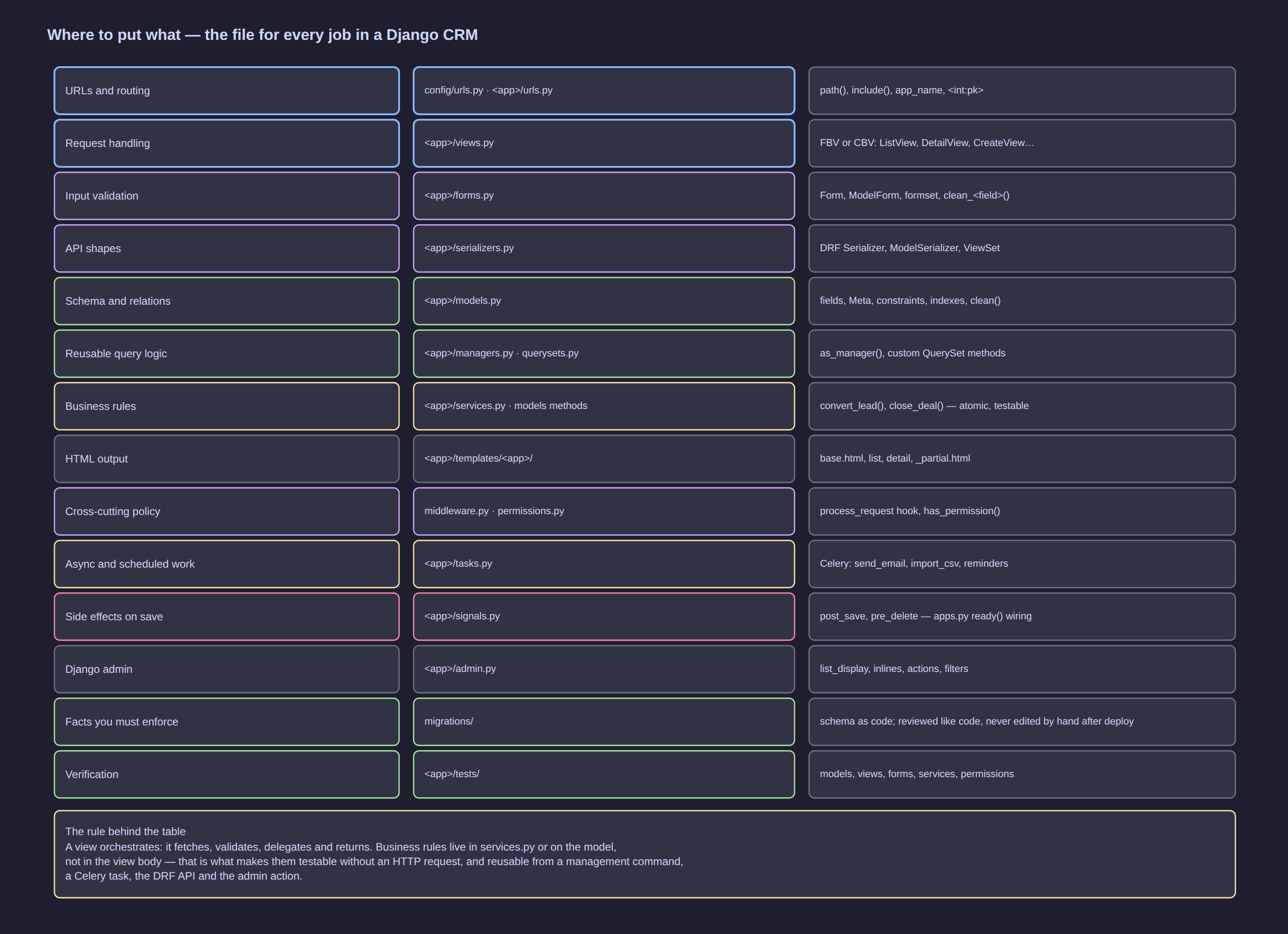
Click the diagram to open it at full resolution.
# deals/services.py — the layer that keeps views thin and rules testable
from django.db import transaction
from django.utils import timezone

from .models import Deal, PipelineStage

def move_deal_to_stage(deal: Deal, stage: PipelineStage, *, user) -> Deal:
    """Business action. Callable from a view, a task, the admin or a command."""
    with transaction.atomic():
        old_stage = deal.stage
        deal.stage = stage
        if stage.is_won:
            deal.closed_at = timezone.now()
        deal.save(update_fields=["stage", "closed_at", "updated_at"])

        Activity.objects.create(
            deal=deal, kind=Activity.Kind.NOTE, owner=user,
            subject=f"Stage changed: {old_stage.name} → {stage.name}",
        )

    cache.delete("deals:pipeline_totals")
    transaction.on_commit(lambda: notify_deal_owner.delay(deal.pk, old_stage.slug, stage.slug))
    return deal
# deals/views.py — and the view becomes four readable lines
class DealStageUpdateView(LoginRequiredMixin, PermissionRequiredMixin, View):
    permission_required = "deals.change_deal"

    def post(self, request, pk):
        deal = get_object_or_404(Deal.objects.visible_to(request.user), pk=pk)
        stage = get_object_or_404(PipelineStage, slug=request.POST.get("stage"))
        services.move_deal_to_stage(deal, stage, user=request.user)
        messages.success(request, f"Moved to {stage.name}.")
        return redirect(deal.get_absolute_url())
# deals/selectors.py — read-side queries, named and reusable
def pipeline_for(user):
    """The pipeline board's data, in two queries."""
    deals = (Deal.objects.open()
             .select_related("account", "contact", "stage", "owner")
             .order_by("stage__order", "-amount"))
    if not user.has_perm("deals.view_all_deals"):
        deals = deals.filter(owner=user)
    return deals

def contact_timeline(contact):
    return (Activity.objects.filter(contact=contact)
            .select_related("owner", "deal")
            .order_by("-occurred_at")[:50])
| Layer | File | Contains | Must not contain |
|---|---|---|---|
| Model | models.py |
fields, constraints, small derived properties, clean() |
HTTP, request, rendering |
| Query (read) | selectors.py |
named, optimised, reusable querysets | writes |
| Service (write) | services.py |
one business operation, atomic(), side effects on commit |
HTTP, templates |
| Form / serializer | forms.py, serializers.py |
validation and input shaping | business rules that other callers need |
| View | views.py |
permission, fetch, call a service, respond | business rules, raw SQL, loops over querysets |
| Task | tasks.py |
slow or scheduled work, idempotent | logic that should be reusable synchronously |
The pattern is not framework-mandated — Django does not ship a services.py — but it is the structure that keeps a CRM maintainable past its first year, and it is what makes the same rule reachable from a view, the API, a Celery task, the admin and a management command.
Anti-Patterns
| Anti-pattern | What goes wrong | Do this instead |
|---|---|---|
| Business logic in the view | untestable without HTTP; unreachable from tasks and the admin | services.py, called by the view |
Fat models with save() doing everything |
every write has surprising side effects, including imports | explicit service functions |
| Queries in a loop | N+1; the page slows as data grows | select_related / prefetch_related / annotate |
len(queryset) to count rows |
fetches every row | .count() / .exists() |
| A template that calls methods on objects | hidden queries per row, invisible in the view | prepare the data in the view or a selector |
if request.user.is_superuser scattered everywhere |
permissions drift and become unenforceable | groups, model permissions, a user-filtered queryset |
Trusting a hidden form field for owner/role |
privilege escalation | set it server-side in form_valid/perform_create |
| Signals for required steps | invisible control flow; skipped by bulk operations | call the service explicitly |
CharField(null=True) |
two kinds of empty in every query | blank=True (and null=True only for dates/numbers) |
Money as FloatField |
rounding errors in totals | DecimalField |
No Meta.ordering |
list order changes between requests | set ordering, or order explicitly |
| Editing an applied migration | environments silently diverge | a new migration |
DEBUG = True in production |
tracebacks leak settings, SQL and paths | check --deploy in CI |
select * on a wide model for a list page |
wasted I/O and memory | only() / values_list() |
|safe on user content |
stored XSS | never; sanitise and render as text |
One app called core with 40 models |
no domain boundaries, no reuse | one app per domain area |
| Tests that hit the network or the clock | flaky suite, slow feedback | mock, freezegun, setUpTestData |
| No pagination on list views | a 100k-row table kills the browser and the DB | Paginator everywhere |
| Cache without invalidation | stale data, intermittently | decide the invalidating write and put it there |
pip install without pinning |
unreproducible builds; a surprise upgrade at deploy | lock file, pip-audit in CI |
Cheat Sheet
manage.py
python manage.py runserver 0.0.0.0:8000          # dev server
python manage.py makemigrations [app]            # models → migration files
python manage.py migrate [app] [migration]       # apply (or roll back to) migrations
python manage.py showmigrations                  # state of every migration
python manage.py sqlmigrate app 0003             # the SQL a migration will run
python manage.py shell                           # ORM shell
python manage.py dbshell                         # psql with your settings
python manage.py createsuperuser
python manage.py startapp <name>
python manage.py test [app.tests.ClassName.test] # run tests
python manage.py collectstatic --noinput         # gather static files
python manage.py check --deploy                  # security check
python manage.py shell -c "from deals.models import Deal; print(Deal.objects.count())"
python manage.py dumpdata deals --indent 2 > deals.json
python manage.py loaddata deals.json
python manage.py clearsessions                   # schedule this
python manage.py prune_contacts --days 365 --apply   # a custom command
ORM lookups and methods
| Need | Call |
|---|---|
| All rows | Model.objects.all() |
| One row or 404 | get_object_or_404(Model, pk=pk) |
| Create | Model.objects.create(**kwargs) |
| Update many | qs.update(field=value) (no signals, no save()) |
| Delete many | qs.delete() |
| Get or create | Model.objects.get_or_create(defaults={...}, **lookup) |
| Update or create | Model.objects.update_or_create(defaults={...}, **lookup) |
| Exists | qs.exists() |
| Count | qs.count() |
| First / last | qs.first() / qs.last() — add Meta.ordering or they are arbitrary |
| Filter | qs.filter(a=1), qs.exclude(b=2) |
| OR / NOT | Q(a=1) \| Q(b=2), ~Q(c=3) |
| Column reference | F("amount") + 1 |
| Aggregate | qs.aggregate(Sum("amount"), Count("id")) |
| Per-row value | qs.annotate(total=Sum("deals__amount")) |
| FK follow | select_related("account") |
| M2M / reverse | prefetch_related("tags") |
| Distinct | .distinct() (needed after filtering on a M2M) |
| Slice | qs[:10], qs[10:20] (no negative indices) |
| Raw | Model.objects.raw(sql, [params]) |
Model fields, quickly
CharField(max_length=200)                 TextField()
IntegerField()  PositiveIntegerField()    DecimalField(max_digits=12, decimal_places=2)
BooleanField(default=False)               SlugField(unique=True)
EmailField()  URLField()  FileField(upload_to=...)  ImageField()
DateField()  DateTimeField(auto_now_add=True)  DateTimeField(auto_now=True)
ForeignKey(Model, on_delete=PROTECT, related_name="…")
OneToOneField(Model, on_delete=CASCADE)   ManyToManyField(Model, blank=True)
JSONField()                               UUIDField(default=uuid4)
ChoiceField via models.TextChoices
class Meta:
    ordering = ["name"]
    unique_together = [("stage", "position")]           # or UniqueConstraint in constraints
    constraints = [CheckConstraint(condition=Q(quantity__gte=1), name="qty_positive")]
    indexes = [models.Index(fields=["stage", "-created_at"])]
    permissions = [("export_deals", "Can export deals")]
    verbose_name = "deal"
Views, decorators and mixins
| Task | FBV | CBV |
|---|---|---|
| Require login | @login_required |
LoginRequiredMixin |
| Require a permission | @permission_required("app.perm") |
PermissionRequiredMixin |
| Require staff | @staff_member_required |
UserPassesTestMixin |
| Require a method | @require_POST |
View + def post() |
| Cache the response | @cache_page(60) |
method_decorator(cache_page(60)) |
| Vary on a header | @vary_on_headers("HX-Request") |
same |
| CSRF-exempt (webhooks only) | @csrf_exempt |
same — and verify the signature instead |
Settings you will actually change
SECRET_KEY · DEBUG · ALLOWED_HOSTS · CSRF_TRUSTED_ORIGINS
INSTALLED_APPS · MIDDLEWARE · ROOT_URLCONF · TEMPLATES
DATABASES · CONN_MAX_AGE · CACHES · SESSION_ENGINE
AUTH_USER_MODEL · AUTH_PASSWORD_VALIDATORS · LOGIN_URL · LOGIN_REDIRECT_URL
LANGUAGE_CODE · LANGUAGES · TIME_ZONE · USE_I18N · USE_TZ
STATIC_URL · STATIC_ROOT · STATICFILES_DIRS · MEDIA_URL · MEDIA_ROOT · STORAGES
EMAIL_BACKEND · DEFAULT_FROM_EMAIL
SECURE_SSL_REDIRECT · SECURE_HSTS_SECONDS · SESSION_COOKIE_SECURE · CSRF_COOKIE_SECURE
The five rules that prevent most Django bugs
- Optimise queries deliberately —
select_relatedfor FKs,prefetch_relatedfor M2M and reverse relations, and check the count with the debug toolbar. - Put business rules in a service or on the model, never in a view body — so every caller, including tasks and the admin, obeys them.
- Validate with forms/serializers (including server-side fields like
owner), and push what you can intoMeta.constraintsso the database enforces it. - Migrations are code: commit them with the model change, review them, and never edit one that has been applied.
- Permissions are enforced server-side on every write, with a user-filtered queryset for reads — the template only decides what to show.
Further Reading
- Django documentation — the versioned reference, and the tutorials are genuinely good
- Django topics: models, queries, forms, views — the part you will read most
- QuerySet API reference — every lookup and method, in one page
- Django deployment checklist —
check --deployin prose - Django REST Framework — serializers, viewsets, permissions
- django-filter — declarative filtering for list endpoints
- Celery — background tasks and scheduling
- django-debug-toolbar — query counts, per request
- Two Scoops of Django — project conventions at length
- Related pages in this KB: PostgreSQL, Docker, React — Complete Guide (ERP Example)