Amazon Mitra-v2 — Tabular Foundation Models and Fine-Tuning
Last reviewed: 19 September 2026
Édition française : Amazon Mitra-v2 — Modèles de fondation tabulaires et fine-tuning
Tabular foundation models come in two families: those that answer straight away (zero-shot, such as Google's TabFM) and those you specialise on your own data in a few minutes. Mitra-v2, released by Amazon, belongs to the second: 77 million parameters, trained only on synthetic data, and designed for fine-tuning. This article explains how it works, what it brings compared with a classical data-science project, and where it stands against TabFM — with the same Senegalese use case as the companion article: the solar production of a house in Badoudou, near Sokone.
What you will understand
- What a mixed synthetic prior is, and why it is the heart of Mitra.
- How a regression can be treated as a classification over 1,000 bins, and why that gives forecasts with uncertainty.
- The difference between a generalist model (zero-shot) and a specialist model (fine-tuning).
- What the public benchmarks say, and how to read a model comparison without being fooled.
- When fine-tuning is worth it… and when it is not.
Prerequisite: having read, or skimmed, the Google TabFM article, which lays out the basic notions (in-context learning, foundation model, test protocol).
1. Recap: why tabular models need a “prior”
A generalist foundation model learns on millions of synthetic tasks. The quality of those tasks — their prior distribution, their prior — determines what the model will be able to do later on your real data.
Two strategies emerge:
- Betting on extreme variety: generating highly diverse tables and relying on in-context learning to adapt to anything, without ever changing the weights. That is the TabPFN / TabFM path.
- Betting on diversity plus specialisation: generating mixed synthetic priors (several families of generators, including a hybrid causal prior), then letting the user adjust a few fine-tuning steps on their own task. That is the Mitra path.
Mitra-v1 (“Mixed synthetic priors for enhancing tabular foundation models”, 2025) showed that more diverse priors produce a model that specialises better and faster. Mitra-v2 pushes the logic further: a much broader pre-training distribution, a context ten times longer, three times as many variables.
2. Architecture: a compact 2D Transformer
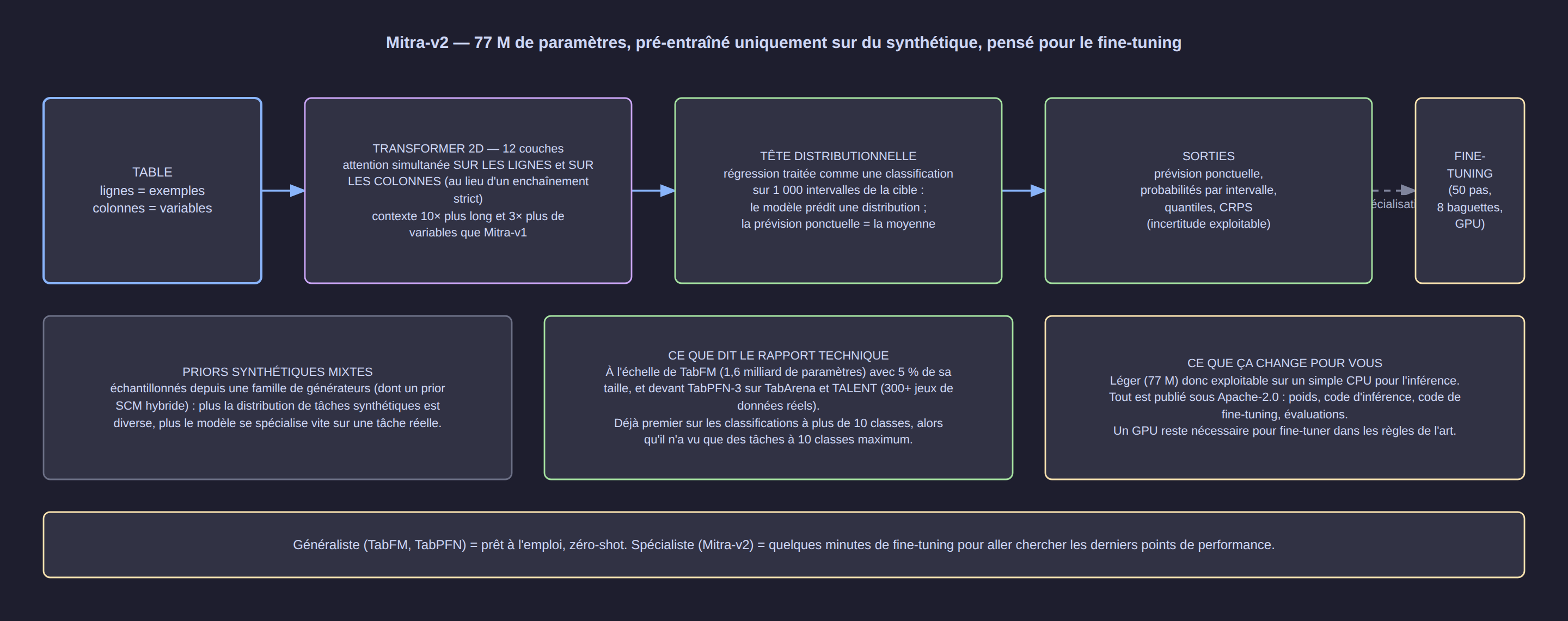
The key points, without unnecessary jargon:
- 12 layers, 76.7 million parameters. For comparison, TabFM announces 1.6 billion parameters: Mitra-v2 aims for performance at a fraction of the inference cost.
- “2D” attention. The model attends to rows and columns at the same time: a row is an example; a column is a variable. Many tabular architectures process those two directions one after the other; here information flows in both directions at every layer.
- Long context. The training rows are passed to the model as context (in-context learning), ten times more rows than in version 1 — that is what makes it possible to work on real datasets, not only on toys.
- A distributional head with 1,000 bins. This is the most elegant idea: for a regression, instead of predicting a value directly, Mitra-v2 splits the target into 1,000 bins and predicts a probability for each one. The point forecast is the mean of that distribution.
The practical consequence: you do not get only “14.2 kWh”, but a distribution — hence quantiles, confidence intervals, and the ability to say “I have an 80% chance of producing more than 11 kWh tomorrow”. For solar sizing, that is exactly what you need: you do not size a battery on an average, but on the bad days.
3. Generalist or specialist: two ways to use a foundation model
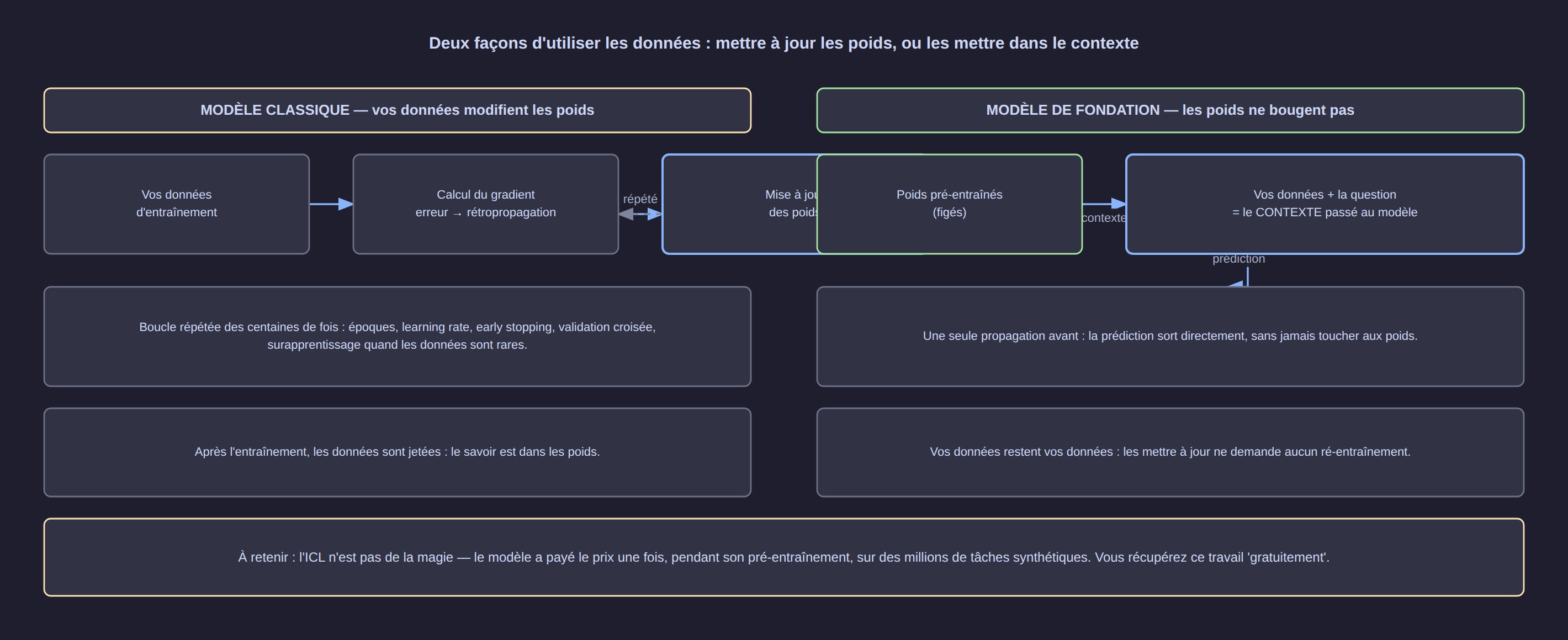
| Generalist (zero-shot) | Specialist (fine-tuning) | |
|---|---|---|
| Examples | TabFM, TabPFN | Mitra-v2 |
| What changes during use | nothing: the weights are frozen | the weights are adjusted on your data |
| Effort | no tuning | a training recipe to run |
| Hardware | CPU is enough for a small dataset | GPU required (the published recipe uses a GPU) |
| Expected gain | very good immediately | the last few points of performance, on a specific domain |
| Main risk | licence and the limits of the domain seen during training | overfitting when data is scarce |
The published reference recipe for Mitra-v2 is 50 fine-tuning steps with 8 “bagged” copies (8-fold bagging): the model is fitted eight times on subsamples, and the eight predictions are averaged. That reduces variance — the main enemy when you have little data.
# Inference / fine-tuning environment for Mitra-v2
uv pip install "autogluon.tabular[mitra]>=1.6" "tabarena>=0.1.0"
[!NOTE] Licence. Mitra-v2 is released under Apache-2.0: the weights, the inference code, the fine-tuning code and the evaluation results. This is a notable difference from weights under a non-commercial licence: here, production use is permitted without prior negotiation.
4. What the benchmarks say (and how to read them)
Mitra-v2 is evaluated on TabArena and TALENT, two benchmark suites bringing together more than 300 real datasets (credit risk, clinical prediction, equipment failure detection, real-estate price estimation…), under two evaluation protocols.
The results announced by the authors:
- performance in the region of TabFM and EXAONE Tabular (the best models in the category), ahead of TabPFN-3 on TabArena, in both classification and regression;
- 5% of TabFM's size (77 M versus 1.6 B parameters) for comparable performance;
- on TALENT, among the leaders, ahead of TabPFN-3 and TabICLv2;
- first on classifications with more than 10 classes, even though the model was pre-trained only on tasks with at most ten classes — a sign that structure learning transfers.
Three reading precautions, valid for any model comparison:
- A ranking is not a guarantee for your problem. Benchmarks aggregate dozens of tasks: the average can be excellent while your particular case is poor.
- The gap between the top three is measured in points. Choosing between TabFM, Mitra-v2 and TabPFN-3 on a leaderboard often amounts to choosing on the licence, the inference cost and the ecosystem (here: AutoGluon, very well tooled, and Apache-2.0).
- Always compare against a simple baseline — mean, linear regression, boosted tree — on your data, with your train/test split.
5. The use case: forecasting the solar output of a house in Badoudou (Sokone)
The dataset is described in detail in the companion article; the essentials:
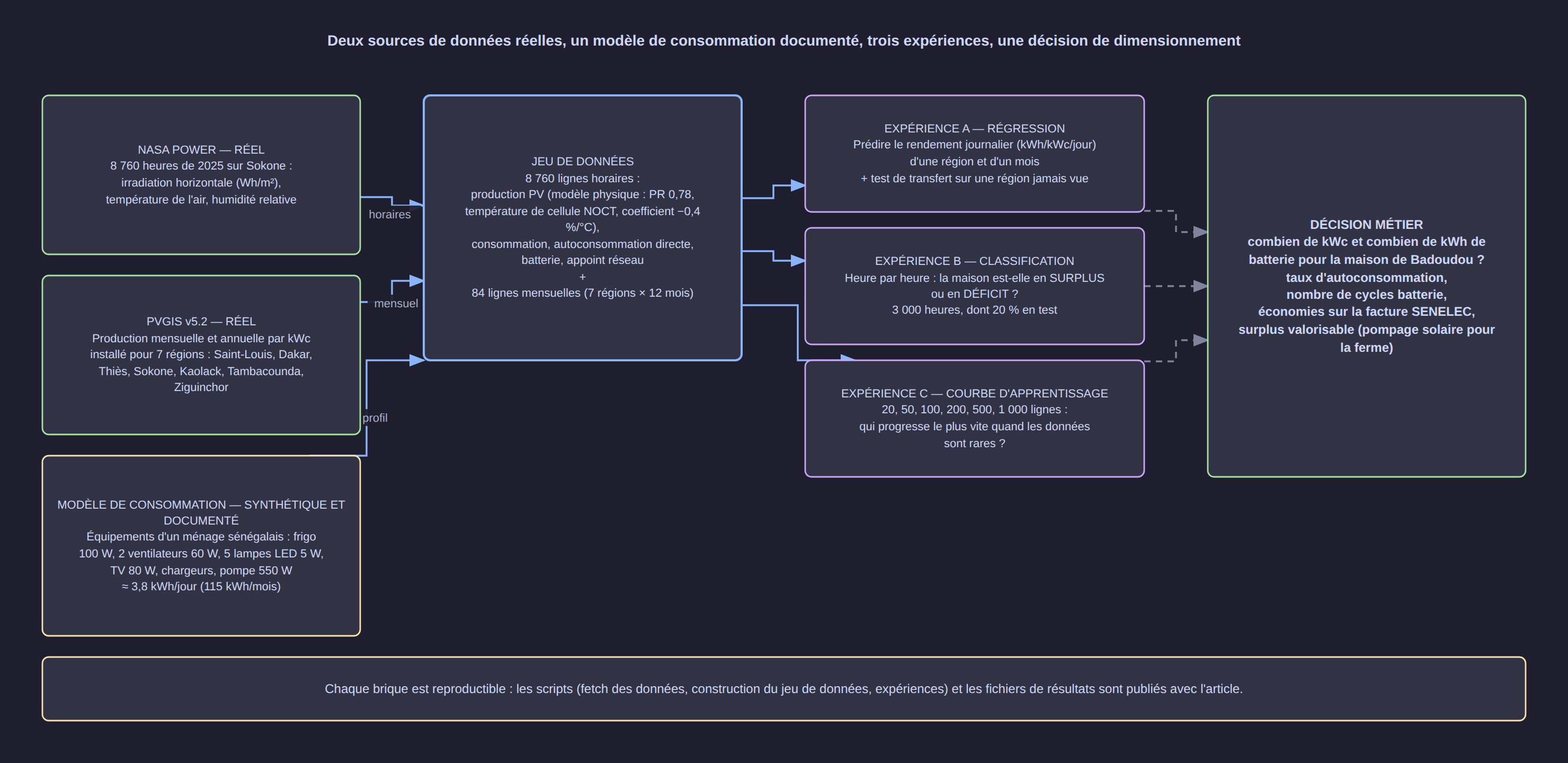
- Photovoltaic production: real data. NASA POWER provides 8,760 hours (2025) of irradiation, temperature and humidity for Sokone; PVGIS gives the monthly yield per kWp for 7 regions of Senegal. Hourly production is computed by a physical model (performance ratio 0.78, thermal de-rating −0.4%/°C).
- Consumption: a documented appliance model. Refrigerator, fans, lighting, TV, chargers, pump: ≈ 3.8 kWh/day, that is 1,378 kWh per year.
- Question: is 1.5 kWp + a 5 kWh battery enough, and what is left to buy from the grid?
The full hourly simulation gives:
| Configuration | Self-consumption | Grid purchase | Annual surplus |
|---|---|---|---|
| 1.5 kWp, no battery | 41.3% | 809 kWh/year | 1,579 kWh/year |
| 1.5 kWp + 5 kWh battery | 97.0% | 1 kWh/year | 728 kWh/year |
| 3.0 kWp + 5 kWh battery | 97.3% | 0.5 kWh/year | 2,880 kWh/year |
With the SENELEC tariffs of January 2026 (82 FCFA/kWh for the first 150 kWh per month), covering 1,378 kWh/year represents about 113,000 FCFA of avoided purchases per year — the details of the assumptions and the full calculation are in the TabFM article, section 6.6.
Where Mitra-v2 brings something specific here: forecasting production is a regression, and sizing an installation for a bad day is the real issue. A point forecast does not say much; a distribution (low quantiles, median, high) says how many days a year the battery will be empty. That is precisely what the head with 1,000 bins provides, and what a simple boosted tree does not give without extra work (quantile regression, bootstrap, conformal prediction).
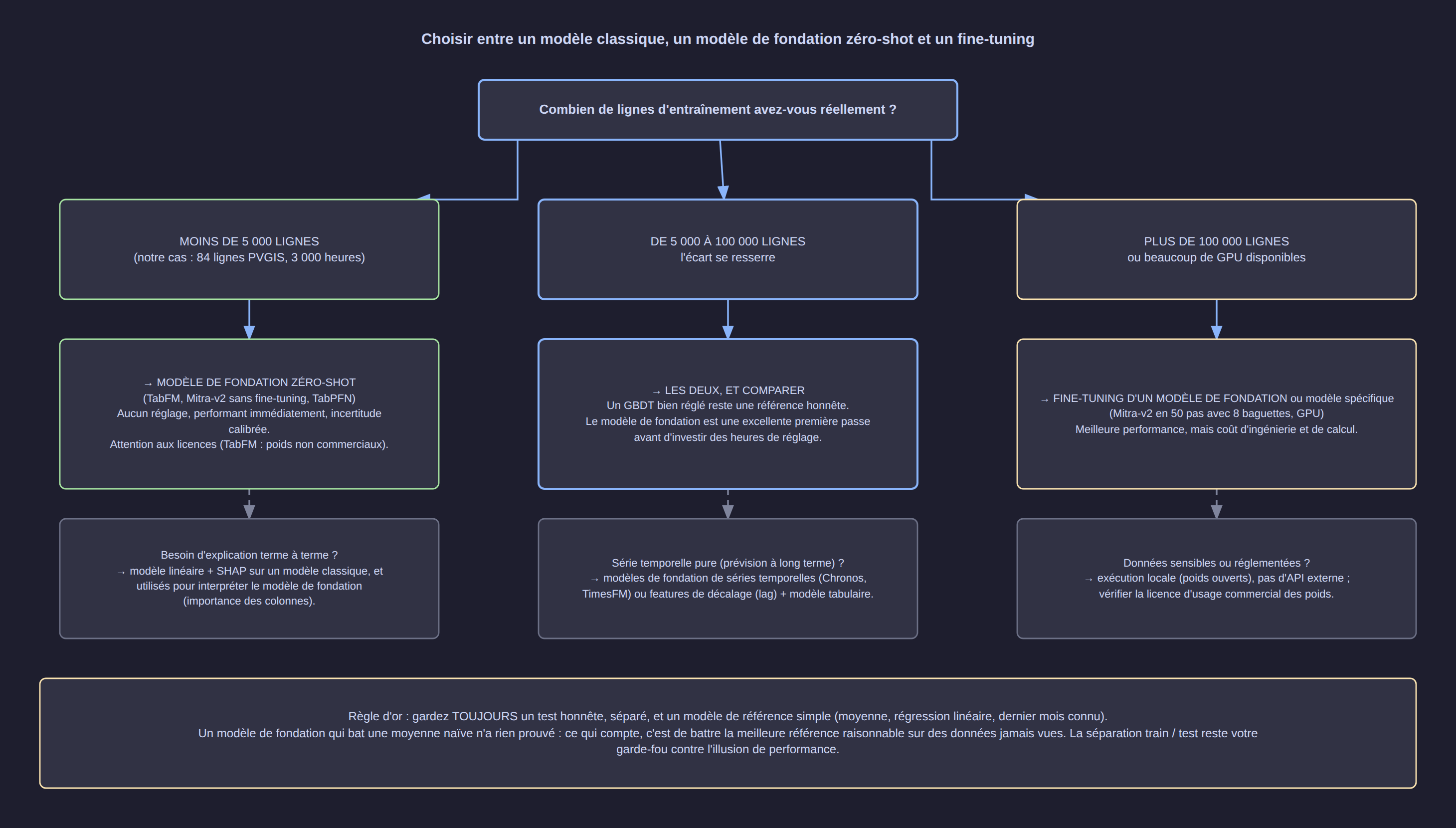
6. Should you fine-tune? The honest calculation
Fine-tune if:
- you have several thousand rows and a GPU;
- your domain is particular (specific sensors, business units, local seasonalities);
- you need the best possible accuracy and a well-calibrated distribution;
- you can repeat the operation at every data update (industrialisation).
Do not fine-tune if:
- you have a few dozen or a few hundred rows: zero-shot already does the job, and 50 fine-tuning steps on 84 rows run the risk of learning mostly noise;
- you have no GPU available: zero-shot inference runs on CPU;
- your problem is unstable over time (the specialised model will have to be rebuilt often);
- you are looking first for a fast answer: zero-shot gives 80% of the result in 20% of the time.
In all cases, the winning approach is a ladder: naive baseline → classical model → zero-shot foundation model → fine-tuning. You only move up a rung if the previous rung is not enough.
7. Limits and pitfalls
- Everything is synthetic. Mitra-v2 has never seen real data during training: domains very far from the priors remain fragile. The model card explicitly invites you to evaluate on representative validation data before any use.
- Fine-tuning = risk of overfitting when data is scarce — hence the 8 bagged copies of the official recipe, which must not be “simplified”.
- It is not a causality tool. The model predicts one variable from others very well; it does not say why, nor what would happen if an input changed.
- Classic mistake: judging on the average. With a distributional head, you can be excellent in probability and average on the mean value. Choose the metric that matches the decision (the cost of a day without battery, not RMSE).
- The hidden cost is industrialisation: versioning the model and the training context, monitoring data drift, and documenting what was fine-tuned and when.
8. Key takeaways
- Mitra-v2 is a tabular foundation model with 77 M parameters, pre-trained only on mixed synthetic priors, designed to be fine-tuned: it reaches the level of the best models in its category with a fraction of their size.
- It treats regression as a classification over 1,000 bins: you get a distribution, hence uncertainty — valuable for sizing a solar installation.
- Everything is released under Apache-2.0 (weights, inference, fine-tuning, evaluations), which removes the licence question that complicates commercial use of some competing weights.
- On the Senegalese case, most of the result comes not from the model but from the protocol: real data, an explicit physical model, an honest test split, a naive baseline to beat.
Resources
- Technical report: Mitra-v2 Technical Report (arXiv 2609.04540); founding paper: Mitra — Mixed synthetic priors (arXiv 2510.21204)
- Amazon Science: Mitra — Mixed synthetic priors for enhancing tabular foundation models
- Weights and code: autogluon/mitra-regressor-2, autogluon/mitra-finetune
- Benchmarks cited: TabArena, TALENT (real classification and regression datasets)
- Companion article: Google TabFM — Tabular Foundation Models (zero-shot forecasting)